This week, my twitching buddies PL & EU were planning a trip to Suffolk, organised by the Hardy Orchid Society, to see a rare Tongue Orchid. There was much to-ing and fro-ing in sorting out the details and at the last minute EU cried off (called by the siren song of a couple of Mega's up north) and then the trip organiser himself fell ill. So in the end PL and myself sallied forth in the Gnome mobile, setting off late morning to arrive at the (undisclosed) site in deepest, darkest Suffolk. The trip took getting on for three hours and with the car's air conditioning having conked out it was a rather hot and tedious drive there. Still we arrived with keen anticipation and set off for the orchid location itself.
There had been a couple of other people on the HOS trip who, in the absence of the organiser, had also made their way there under their own steam and one of them took us under his wing and lead us straight to the exact location. And there it was, sitting unobtrusively in a wildflower meadow on the private site. There were three stems, one very much on the way out, one in fine fettle and one a bit on the runty side. We set about taking photos as best we could though unfortunately the sun was positioned on the wrong side of the plants. We were under strict instructions by the site owner to avoid trampling at all costs and to stick to the designated path.
The Greek Ploughshare Tongue Orchid, above and below
Here showing the relatively small size at about 15cm tall in amongst the Buttercups
The lovely wildflower meadow in which the Tongue Orchid was located
So, what of the provenance of these plants? Firstly, there had in fact been some debate about their identity before it was pinned down (see here) by "Mr Orchid" SC and Kew Gardens as being Serapias bergonii. This species is commonly known as Greek (or Eastern) Ploughshare Tongue Orchid and is a native of the southern Mediterranean and Balkan countries as far west as Italy. It was formerly classified as a subspecies of various other Tongue Orchids before being declared a species in its own right. The Suffolk specimens were originally thought to have been planted there but the owner of the private land where they are located refutes this so they must have arrived under its own steam somehow. Anyway, it was good enough for me and I enjoyed this latest addition to my UK Orchid list.
Having got our fill of these Mediterranean exotics, we went on to our second location. This was very much a bonus visit that the trip organiser had set up, but in his absence we were happy to follow his itinerary. The target was the rare Ochroleuca variety of Early Marsh Orchid, a plae creamy variation on this already quite colour-varied species. Along with our new-found orchid companion, we made our way to the target site where we were greeted by the sight of a lovely boggy fen to tramp about in. Our pin-drop information turned out to be useless so we were left to find them ourselves. In the end it was easy enough, as their pale creamy colour stood out from the lush green vegetation quite strongly. There was also the clue (as always) of the trampling surrounding them.
Above and below Ochroleuca Early Marsh Orchid
One aspect of orchiding that I really like is the rummaging around in a bog (or wherever) by myself seeing what I can find so I soon wandered off. I managed to turn up a few more ochroleuca myself as well as some schoenophila varients of Marsh Orchid. The latter are what were formerly know as Pugsley's or Narrow-leaved before they decided to reclassify all the southern ones to this subspecies of Southern Marsh. Having got my eye in on Anglesey on my recent trip there, I was pleased to have picked out it's look-alike for myself.
Above and below - there were plenty of Southern Marsh Orchid
Above and below schoenophila Southern Marsh, or "pseudo" Pugsley's as I call them
Rummaging around in a bog - what could be better?
After a while PL and I decided that we'd had our fill and wandered contentedly back to the car. Then it was back on the road for the long slog back home. We both agreed that it had been a most excellent trip out. With a new orchid tick and a new subspecies tick as well, along with some top class bog rummaging, it had been a grand day out.
My son has come to the end of his first year at York University. How time flies! It seems like only yesterday that I was taking him up for the start of it all and yet here I was getting him back again. As always, the trip up north offered an opportunity for me to see something en route. I had been hoping for a Big One ("late and alone") to turn up but in the end the only action was in Shetland so I had to make do with things other than birds. I got to thinking that it would be a good opportunity for me to work on my orchid list which is now getting close to being complete. The obvious choice was Lady's Slipper Orchid which should be in full bloom around about now and easily visitable at Kilnsey Park, near Skipton in Yorkshire. However, a phone call to the lodge there during the preceding few days determined that sadly, due to the hot dry spring we'd had, everything had been a couple of weeks early and they'd all gone by now. Having now got the idea of orchid'ing into my head, I was determined to find something else to visit. The only other candidate that I still needed that wasn't up in Scotland was Pugsley's Marsh Orchid which should now be in full bloom. However, the best location for this was on Anglesey which was not what you might typically call en route to York. Still, it was at least going north and would have to do. In the end, I decided to go up in the afternoon the previous day and stay overnight nearby. I could then spend the morning knee deep in the local bogs before heading east towards Yorkshire in the afternoon. I could even catch a bit of early morning raptor watching at Wykeham Forest the next day before heading into York to pick up my son and then head back home to Oxford. The plan had been hatched - but how would it all turn out?
So it was that on Sunday afternoon I loaded up the Gnome-mobile and headed north on the M6 and then west along the A55 towards Anglesey. I arrived at my AirBnB in Pentraeth on Anglesey at around 8pm. This was ideally located no more than 5 minutes from Cors Bodeilio, my target location for the trip. The AirBnB turned out to be very basic but was in a quiet location and the bed was very comfortable. After a quick walk to the local shop to buy some provisions and to stretch my legs I was soon settled in for the night.
After a good nights sleep I was breakfasted and out of the door at 8am. As I said, it was literally only 5 minutes up the road to the parking area for the Cors Bodeilio reserve. This is one of three alkaline fens on Anglesey, along with Cors Goch and Cors Erddreiniog (Cors being the Welsh for "bog") - see here for an overview. Most bogs are acidic in nature but the surrounding porous limestone rocks mean that the water that filters through is alkaline in nature, making for a unique and rare ecology. This habitat is home to a variety of rare plants and insects, including my sought after target today, Pugsley's Marsh Orchid. Also known as Narrow-leaved Marsh Orchid, this was originally thought to be a much more widespread species. Indeed I remember ticking it for myself at Cothill Nature Reserve in Oxforshire a number of years back. However, the orchid powers that be decided after detailed DNA analysis that all those south of a line from the Severn to the Wash were actually subspecies of Southern Marsh Orchid. I don't know of other reliable sites for Pugsley's but I had been told by "Mr. Orchid" SC that Anglesey was the best bet and he'd given me detailed instructions of where to go. All that remained was for me to hope that these hadn't gone the way of the Lady's Slipper Orchids and were in fact still in flower. Having arrived, now was the moment of truth.
The Cors Bodeilio Nature Reserve
The gate from the parking area lead immediately onto a large wooden boardwalk that circumnavigated the north side of the first part of the reserve. I was greeted by a large boggy vista with some orchids immediately on view. That was a good sign! Closer inspection revealed these to be mostly Northern Marsh Orchids with some Early Marsh, Common Spotted and Heath Spotted Orchids in amongst them. I realised that it had been a few years since I'd done much orchid'ing (apart from chasing down Scottish rarities) and I was rather rusty on the commoner species. I hastened back to the car to get my field guide to remind me what I was supposed to be looking for and gradually it all started to come back to me. There was also a nice cluster of Marsh Helleborine right by the path. It was a beautiful morning and the air was full of bird song. A reeling Grasshopper Warbler was a pleasant surprise and Willow Warblers and Meadow Pipits were singing everywhere.
The bog as viewed from the boardwalk
Marsh Helleborine
Early Marsh Orchid
At the end of the boardwalk I went off-piste and carefully followed my instructions to the pin drop, eventually ended up at a suitably boggy area where suddenly there were plenty of Pugsley's Marsh Orchids. To be on the safe side I messaged a snap of one to SC who confirmed that I had indeed secured my prize. I spent some time tramping around looking at all the lovely orchids. They were mostly Pugsley's in this area with a few other species as well. After quite some searching I eventually found a couple of Fly Orchids - apparently very rare in Wales.
Pugsley's Marsh Orchid above and below
A Fly Orchid - very rare for Wales apparently
After a while I felt that I was done and ambled back towards the car, taking in all the sights and sounds. Now that the sun was up some dragonflies were on the wing though I only saw Four-spotted Chasers. In a month or so it would have been a great site for Common Hawker but it was far too early. I spent some time in the car having some tea from my flask and wondering what to do next. I'd mentioned raptor watching for the next day but a look at the weather forecast for Yorkshire showed heavy rain and strong winds forecast for tomorrow. Hmmm, if I was to have any chance with raptors it would have to be today. So in the end I decided to head directly there now rather than spending any more time on Anglesey. With a long four hour journey ahead of me, I fired up the Gnome mobile and headed east, stopping for lunch and a tea break to ease the journey.
Towards the end of the journey a bit of a cock-up with the Sat Nav meant I had to retrace my steps and added half an hour to my journey time so it wasn't until around 5pm that I arrived at the Wykeham Raptor Viewpoint car park and walked the few hundred yards to the viewing location. This turned out to be a nice open area with a great view out over the valley towards a large wooded area opposite. It was well equipped with a couple of large benches and there were about a dozen or so people there. The vibe was rather anti-social and there didn't seem to be much talking between the various parties. I cautiously asked about recent sightings to be told that nothing had been seen for quite some time.
The vista from the Wykeham Raptor Viewpoint
I was late to the party but it was a pleasant evening and I was happy just to stare out into the countryside and to unwind after my long drive. People started leaving fairly soon after I arrived so in the end it was just myself and a couple of others - a local from York and a visting birder from Surrey. We got talking and in the end had quite a good time. After a very quiet period things started to pick up and we had a couple of Goshawk sightings and some Common Buzzards as well but no Honeys. Crossbills and Siskins would fly over regularly and often sit in the surrounding trees. A lovely Willow Warbler was flying from tree to tree and marking out its territory with song right in front of us. It was all very pleasant. Eventually I decided that it was time to leave and headed back to the car. My host for the evening had given me some info on where to eat and I settled on a local pub on the way to my AirBnB. The AirBnB itself was a lovely characterful old mill house in the middle of nowhere about half an hour outside York. After chatting with my hostess for a while I was soon settled into bed for the evening.
The next morning the predicted rain and wind had indeed materialised so I didn't hurry. Instead I had a leisurely breakfast while chatting with my hostess. In terms of what to do, Kirkham Priory ruins caught my eye on the map as somewhere to stop off at on the way to York and so at around 9am I set off. This turned out to be a lovely spot by the scenic River Derwent with a small YWT woodland reserve nearby. A quick wander along the river through the reserve found a lovely party of young Marsh Tits blundering about in the woods and all sorts of other birds singing away now that the rain had stopped. It was all very beautiful.
The picturesque River Derwent
Kirkham Priory ruins across the River Derwent
A recently fledged Marsh Tit
Then it was back into the car and on into York. The rendezvous with my son went smoothly and we were soon on our way down south. It was a long old slog after two full days of driving already and the car's air conditioning seemed to have stopped working so it was very hot. However, with a couple of pit stops for lunch and then some tea we made it back by mid afternoon. It had been a very successful Uni run with another new orchid species under my belt.
It is universally agreed that up until recently it had been a very poor spring for birding in Oxon. Patch birding has been unusually poor: my own Port Meadow patch dried up mid April and birding was essentially over there until the autumn. County wide there had not been anything particularly "good", just a light sprinkling of what one might usually expect. That did shift a little with the discovery of the Temminck's Stint at North Cross Valley Way - certainly the bird of the spring so far in the county though there was not really any competition for that accolade.
Now, nationally there have been three "influxes" this spring: Hoopoe, Temminck's Stint and Red-footed Falcon. We'd managed to get the Stint so that was at least one of them. There had in fact also been a Hoopoe in a Witney garden that was suppressed on the wishes of the owner. What about the Falcon though? It seemed that these charismatic birds were going to give our county a miss despite turning up in numbers all over the place. Suddenly a couple of weeks ago that all changed when a Red-footed Falcon was found along the Thames at Standlake just south of Pit 60 by SM. Cue a mass twitch by the county's finest. Unfortunately I was laid up ill in bed for the two days it was present and only made it down there on the third day where I passed a pleasant few hours in the company of EU and MP not seeing much at all but having a good natter in the process. Thank heavens I didn't need it in the county, having seen one close to the Bucks border at Piddington in 2020. Still, I was smarting from missing a good county bird that I could have seen had I only been well enough.
Yesterday things stepped up another whole gear when a mysterious report of a Savi's Warbler at Otmoor hit the news service in the morning. It wasn't from a local as that would have been published on the local WhatsApp channel. Eventually the source was traced to a Facebook post from a visiting Scottish birder who stated emphatically that it was a Savi's and not a Gropper. An advance party in the form of ultra keen uber-birder TM, armed with a parabolic dish and recording equipment, managed to confirm the ID. Apparently Savi's reel at 4kHz compared to Groppers at around 5.5kHz. So it all kicked off.
In the morning a good number of county birders managed to connect before things got quieter in the afternoon. Now I had been stuck in various stressful meetings until the early afternoon and must admit to sweating somewhat under the strain of reading regular updates of it being seen while not being able to head out myself. Whilst I could live with missing the Falcon, this was a county first for everyone and not something to be missed if at all possible. At least it wasn't a lifer - I'd seen one at Lakenheath back in 2013. Accordingly, I made plans to turn up in the evening when Savi's traditionally start singing more actively again. I arrived in the car park at around 5:30pm and started the long slog towards the second screen where the bird was located. I met GB and SH coming back. They looked hot and tired and reported that they'd had a couple of glimpses in the three hours they'd been there but it had been hard work. Hopefully things would improve as the evening came on, I thought as I pressed onwards to the twitch site.
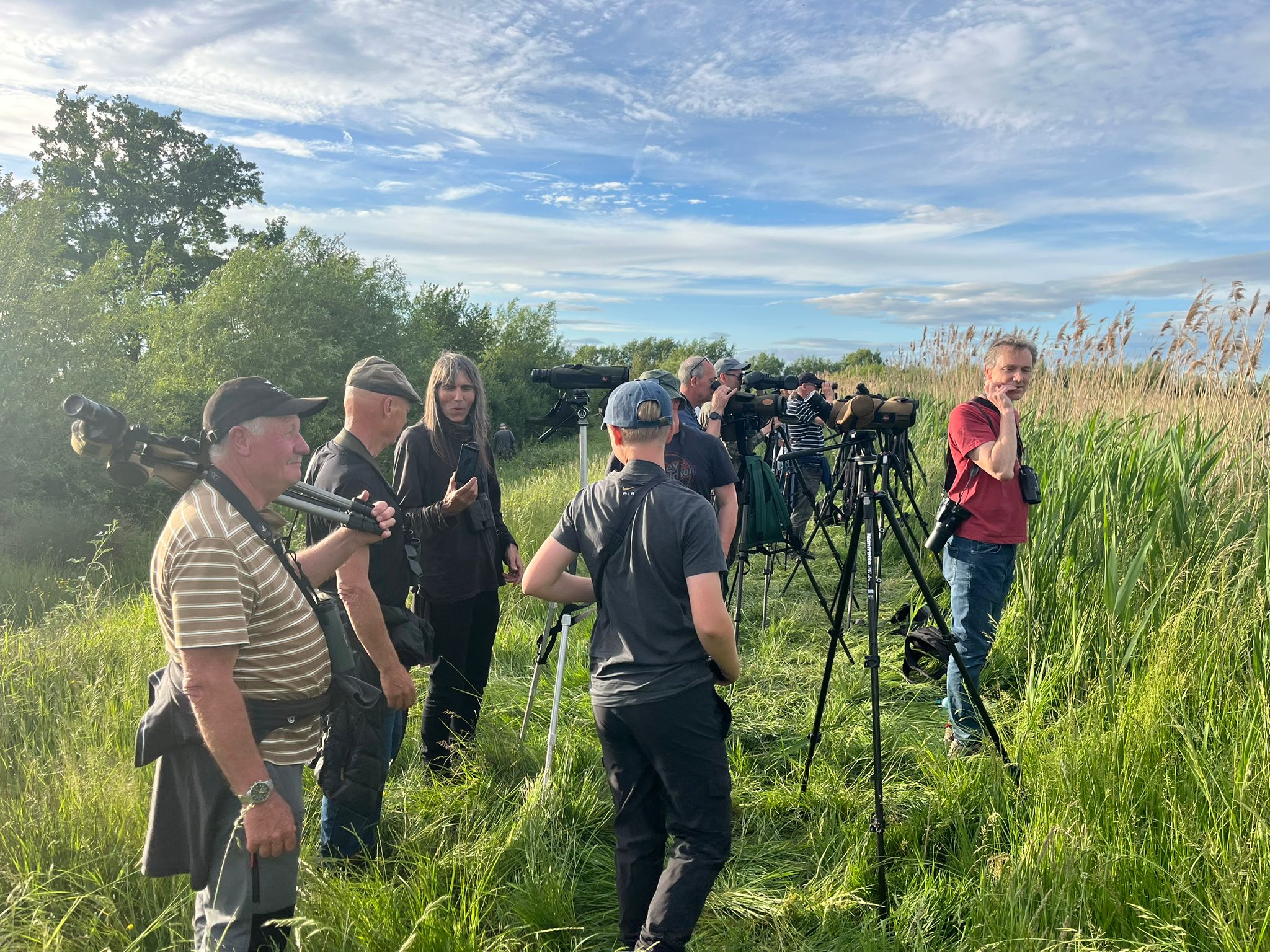
I arrived to find the county's great and good all assembed near the second screen peering intently into the reedbed. Viewing was not easy: there were straggly tall reeds right in front of us partically blocking the view and we were not too much above the height of the reedbed so it was hard to see. I was soon filled in on where to look and joined in the vigil. I started to realise that there was a distinct advanted to being tall in this situation. With my short height it was hard to see much.
There are disadvantages to being short!
Soon a much younger birder behind me reported that the bird was reeling. I had been resigned to perhaps just getting this bird as "heard only". However, tragically, try as I might I couldn't hear the bird at all. Was even hearing this bird going to be beyond my aged hearing abilities? I started to worry. Thankfully, a little while later it sang from much closer and there was no problem with hearing it at all. That was the heard-only tick at least in the bag. Now, if only we could see it.
Oxon's finest staking out the reedbed courtesy of Justin Taylor
The singing became more frequent until JC said "I've got it!". It was along a channel that was positioned more or less directly away from us that we could look down. It was still well hidden and the best I could manage with my limited height was a partially obscured glimpse before it dropped down. How frustrating! A little while later JC found it again, this time much less obscured. In the scrum that followed it was hard to get an unobscured view but eventually just about everyone got onto it. Except me that is who was still struggling to see it. Fortunately JT got it in his scope and I could finally see it properly. Amazingly it was completely unobscured - a rare sight for this species. A few seconds later and it disappeared but everyone had seen it.
The Savi's Warbler courtesy of Roger Wyatt
..and digiscoped courtesy of Ian Lewington
After this, there was much rejoicing and the crowd became more relaxed. The bird carried on singing every fifteen minutes or so but, having seen it, people started to drift away. Whilst I'd seen it, I was still thinking that it would be nice to see it again and I was still carrying around some of the stress from my meetings that morning so wanted to linger in the pleasant evening countryside of Otmoor. So I hung on as the crowd diminished until it was just myself and a couple of late comers who had missed all the action. Weirdly the bird stopped reeling after about 8pm and didn't sing again by 8:30pm when I decided to head back. I took my time back to the car, savouring the evening light and the gentle bird song all around me. It was all very beautiful and just what I needed to ease away the stress. At the first screen I met SS who was waiting patiently for the Glossy Ibis to come into roost. I watched with him for a while but eventually left. He reported that it finally arrived at just before 9pm.
The first screen in the gloaming
Otmoor sunset
I ambled back to the car and headed for home in a reflective frame of mind, enjoying the stillness of the evening. It had been a very pleasant outing and great finally to get another county tick after far too long an interval.
I've been on a number of local outings to see things of interest so far this year. This has partly been driven by the poor spring performance of my local Port Meadow patch and partly just to add a bit of variety to my birding routine. I had been meaning to blog about these more regularly but somehow things got away from me. So without further ado, below are some of the nice county birds that I've seen this year.
Otmoor Green-winged Teal
This species is a bit of a county Mega with surprisingly few county records over the last 17 years or so that I've been county birding. I saw the Standlake bird in 2018 but that's been the only one. Compare that to American Wigeon where I've seen three in the county already. So when one was found in January of this year I decided to head out on a sunny Saturday morning to pay a visit. It was on show from the first screen fairly regularly and made for an enjoyable morning out. Now if we could only have one on Port Meadow...
Above and below the Green-winged Teal
Oxford Greater Scaup
This bird had been at Farmoor but in January hopped over to Hinksey Lake in Oxford. I was looking for an excuse to get out of the house and decided to walk there to get some exercise. It had been quite a few years since I'd visited Hinksey Lake - I used to go fishing there back in the day so it was nice to see it again. The bird was a bit more distant than when it was first found but I enjoyed seeing this species so close to home.
The Hinksey Greater Scaup courtesy of Gareth Cashburn
Farmoor Slavonian Grebes
A pair of these Grebes turned up on Farmoor one day, looking very smart in near full summer plumage. It had been a few years now since I'd seen one so I went to take a look. They were on show the whole time albeit rather distant. Nevertheless it was great to see them in their summer finery.
The two Slavonian Grebes
Temminck's Stint
Temminck's Stint used to be a bit of a speciality bird of my local patch of Port Meadow though there was no chance this year with the floods drying up there depressingly early in this very dry spring. However, Thomas Miller (see here) found one of these smart little waders on the hot new county site of North Cross Valley Way. A quick 20 minute drive from home one Sunday morning in May allowed me to admire this cracking little bird in what turned out to be a very nice looking site. One could easily imagine something stonking turning up there and fortunately the site is becoming quite well watched now.
Some video footage of the bird.
The first birders on the scene with me in the foreground digiscoping, courtesy of Justin Taylor
Birding has been depressingly quiet in Oxon this spring. On my local Port Meadow patch the floods dried up mid way through April and I haven't even bothered to visit for the last couple of weeks. There was the brief flurry of interest with a Temminck's Stint over towards Witney one day (I'll blog about that separately) but that's been about the only decent bird this spring. So this weekend, with nice weather forecast, I decided to treat myself to a bijou birding sortie. Nothing too long distance but just a nice morning out somewhere. One target which had caught my eye was the White-spotted Bluethroat at Slimbridge. This had been reported regularly for the last week or so as back on territory for it's fifth consecutive year. One has to feel for this bird, gamely returning each year and singing its heart out all to no avail. Still, it was a nice opportunity to see a bird that I've been meaning to visit for a number of years now. The main reason why I'd not been to see it previously was that I'd already seen a Bluethroat, down in Cornwall at Land's End, back in October 2008 (see here). Now, that had been a first winter male so it wasn't possible to pin it down to the White-spotted or Blue-spotted subspecies. So this would be a sub-species tick for me. I therefor decided to pay a visit on Saturday to try to see it. In any event, it was always nice to visit Slimbridge in the spring time.
From my research, the bird seemed to show best first thing in the morning and as a card carrying member of the Simbridge WWT I was allowed early access at around 8am to the reserve. So I was up at 6am and left the house at 6:40 arriving at Slimbridge after an uneventful journey on the quiet roads at just before 8am. There were about half a dozen of us with a similar idea who assembled by the side gate to be let in by the warden just after 8. We all yomped off on the ten minute walk down the Summer Walkway to the Shepherd's Hut overlooking Middle Point on the River Severn.
The Bluethroat reedbed
The Hut overlooked an area of reedbed, roughly divided into three by lower, grassy areas. A few strategic long bare twigs had been set up with one in each of the three sections apart from the one directly in front where there were two. The distance from the Hut to the back of the reedbed was about 80 metres so it wasn't exactly close viewing though from our elevated vantage point we could see well enough. A couple of people were already there when we arrived and they reported that the bird had been seen already that morning so hopefully it was just going to be a matter of time. Indeed within about 10 minutes of my arrival I spotted it on the furthest of the two twigs in the reedbed in front of us and called it out to the assembled group. It stayed up there singing away for a good couple of minutes offering clear views. I busied myself with some digiscoped video (which came out rather hazy) and some phonescoped shots.
A passable (given it was hand-held) phone-scoped shot of the White-spotted Bluethroat
Some rather hazy video - set the quality to HD 1080
After its initial showing it showed regularly enough, often in the reedbeds when it was partially obscured and sometimes back on its favourite twig. We could often hear it singing away it's scratchy little song.
Fellow admirers of the Bluethroat by the Shepherd's Hut
The weather was beautiful, the bird was regularly on show and we were
being serenaded by Reed and Sedge Warblers along with a distant calling Cuckoo. This was just what I needed to recharge the batteries! I got chatting with the person next to me who lived reasonably locally. He told me that he's been to see this bird for the last five years and that this was the best it had ever shown. Apparently the first year you would have to wait several hours for a brief view of a few seconds. I was suitable grateful that my views were so good by comparison. No doubt the improved weather was a contributing factor in its relative showiness today. Also maybe it's just getting desperate to attract a mate after all this time.
After a while things started to go a bit quiet and I decided it was time to head on. So I ambled back towards the main part of the reserve, stopping off at every vantage point to see what was about. The main birds about on the estuary area were a few Greylag and Canada Geese the odd Shelduck as well as a couple of distant Cranes from the release scheme. Back in the main reserve I stopped off at each hide to see what was about. I decided to set up an eBird day list just for fun and busied myself with ticking things off. I arbitrarily set myself a target of 50 birds just to make it more interesting.
The Peng Observatory had lots of lovely Avocets fussing about the place and generally making quite a racket. According to a Slimbridge Tweet there were some wild Pochard in the Eider pen which duly went on the day list. I made my way over to the Zeiss Hide, which is the other main hide for viewing wild birds apart from the Estuary Tower. Here I found the Glossy Ibis but couldn't see the Garganey that had been around yesterday. Redshank and Lapwing were to be seen on the water along with more of the usual stuff. I spent some time surveying the scene and taking it all in
A distant photo of the Glossy Ibis using the SuperZoom Camera
Next I headed over to the South Lake Discovery Hide where Cattle Egret and Black-tailed Godwit went on the list. Everywhere birds were busy in the spring sunshine, feeding, preening or loafing.
A rather over-exposed shot of the Cattle Egrets
My day list was tantalisingly close to my target on 49 species but I felt I'd had enough so I headed over the café for some refreshments before my journey home. Back in the car I fired up the Gnome mobile and headed off, still looking for that elusive last tick. I decided that the canal would be my cut off for the list and fortunately as I was waiting by the swing bridge for it to re-open to traffic a Starling flew over, giving me my 50th tick.
As I drove back I reflected that this had been the second trip in a row where the prize had been a subspecies. I am more and more inclined towards including subspecies in my listing. It means that some of the great birds that I've seen over the years such as Eastern Black Redstart, American Horned Lark, Azorean Yellow-legged Gull, Steppe Grey Shrike etc are all recognised for the quality birds that they are. After all, it's "my list, my rules" !
My two older daughters have now passed through the Uni system so no longer provide me with excuses for birding excursions further afield. However, my son is only in his first term at York so there should be a few more years with him. Whilst he does have a room in halls for the whole of the first year, for some reason they wanted to kick him out over Easter - presumably because they wanted to rent it out for a conference. This meant that I had to make two trips over the Easter period over the space of just two weeks. Now, had it been in the middle of autumn I wouldn't have minded but April in the north east is often pretty quiet so I wasn't expecting much. Indeed on the trip up to fetch him there was almost nothing worth going for apart from the long staying Dark-breasted Barn Owl that had been entertaining birders far and wide near Bourne in Lincolnshire. Whilst this is only a sub-species, being the continental form of our own Barn Owl, it would still be a sub-species tick for me and in the absence of anything better I thought I'd have a go. In the end circumstances contrived against me and I could only manage a couple of hours around midday to look for it. Now this bird was known for best being seen early morning or late evening so this was the worst time to try. I duly passed a couple of dull hours staring at a field and some infant Christmas trees before giving up and heading on northwards to fetch my son home.
For the return leg, things were looking more promising. An Eastern Subalpine Warbler had been found at Filey in Yorkshire a couple of days prior. However, the day before it was only seen once briefly late afternoon and by all accounts was very difficult to connect with. It was a shame as Filey was only an hour from York and I need Eastern Subalp for my UK Life List but it just didn't seem reliable enough to warrant having a crack at it. In any event it wasn't reported at all while we drove north to York. There was an added possibility when a female Subalp that was thought to be Eastern was found at Flamborough on the morning of our trip. However opinion later shifted to Western or Moltoni's and that disappeared soon after being found. So having dropped my son off, I decided that there was nothing worth trying for apart from my fall-back option of the Dark-breasted Barn Owl. Even this was only being reported sporadically these days but my hunch that this was more to do with lack of birders trying to see it rather than any change in habits on the bird's part. I hatched a plan to be at Bourne for the evening and to stay somewhere nearby so I could try again early in the morning should I not connect the night before. Accordingly I went ahead and booked an Air BnB near Bourne.
Since it was still early afternoon and I had nothing better to do, I thought I would drop in at RSPB Blacktoft Sands en route. This is one of my favourite reserves with lots of hides to look through all a close distance apart. So I set off on the hour long journey from York, arriving at around 4pm. I then passed a very pleased time ambling between the hides seeing what was about. To be honest, with the tide in there was not a great deal to see apart from Marsh Harriers over the reedbeds and Tree Sparrows in the hedges. Still, the sun was shining and there was lots of Reed and Sedge Warblers singing all around me and I took some time to relax and just enjoy being out in nature.
Above & below, Marsh Harrier over the reeds
The last hide held half a dozen noisy Avocets which were fussing about, complaining about every Marsh Harrier that flew anywhere near and generally making their presence felt. I sipped some tea from my flask and fell into a sort of reverie of stillness, taking it all in and just being content to be where I was.
It's always lovely to see Avocets
Eventually I decided that it was time to move on so I headed back to the car and set the Sat Nav for the wonderfully named "Bah Humbug" Christmas Tree Farm near Bourne, some two hours away, With the time being 5:30pm now, that would get me there in time for the evening showing (should it happen). The journey was uneventful and with Radio 4 for company I duly arrived at the predicted time. I parked up opposite the Christmas Tree Farm and got out to stretch my legs for a bit before retreating back to the car due to a rather chilly breeze that had sprung up. After about 15 minutes a car pulled up with a local inside who wound down the window and asked if I'd seen it yet. He said that it was still very much around but the morning was usually the best time and that he was just driving past on the off chance. After our chat he drove off slowly down the road before suddenly stopping and waving his arm frantically out the window. I needed no second invitation and ran down the road towards him. He told me that he'd just seen the bird fly out of the grass and off behind the line of conifers which bordered the farm buildings. So I'd missed it but at least it was around and actively flying this evening. In an optimistic frame of mind I went back to my car to watch through the open window. A few minutes later another car drew up nearby and stopped. "What are they looking at?" I wondered - then I realised: there was the Owl hunting close to the road in some rough grass next to the Christmas trees! I watched as it hunted low over the grass, beautifully lit in the low evening sunlight. As it flew past me I hoped it would stop and perch on one of the Christmas trees as I'd been told it often did but it didn't. Instead it continued to quarter back and forth along the stretch of road, never going very far and constantly in view. In the end I opted to take a bit of shaky hand-held video footage with my camera by way of a record shot. This actually came out better than expected.
You can set the resolution to HD 1080 for a sharper image
It was a very striking bird with a noticeably dark breast (who would
have guessed!?) and a lovely gingery hue to it. It was altogether very
obviously different from our own native Barn Owl. After about 5 minutes
it headed off out of sight and the local and I both decided to move on.
I went into Bourne to grab a bite to eat before heading off to my Air BnB which was located down a quite road in the middle of nowhere. Some of the back roads were comparatively narrow with a rather deep ditch on one side so I drove carefully in the dark. I was very tired by the time I got there though thankfully the room was comfortable as well as very quiet in its rural location and I was soon asleep.
Having already connected with the Owl, I felt no need to get up early for seconds and instead opted for a bit of a lie in. With nothing else planned I decided to check out a couple of local nature reserves just to get a flavour of the local habitat. The first was Willow Tree Fen which turned out to have some breeding Cranes there. Unlike the reintroduced Otmoor birds in Oxfordshire, these were wild birds. They'd bred for the first time in Lincolnshire in 2020 during the lockdown when the reserve was closed to the public (and so less disturbed). To try to keep them breeding there, the LWT shut down the path across the reserve and instead built a raised viewing platform where the whole site could be surveyed. It worked well and I was able to year tick two Cranes from right next to my parked car. Apart from that there were the usual wading species that one might expect from such a site. It was all very pleasant.
Very much a record shot of one of the two Cranes on show
After that I went to Baston Fen, where one was able to walk along a
raised dyke that overlooked a large area of farmland. Indeed I
recognised the dyke as having been distantly on view from the Barn Owl
site from last night. There was nothing of particular note to see but it
was nice to amble along in the sunshine, listening to all the spring
bird song.
A Reed Bunting at Baston Fen
Fenland landscape at Baston Fen
Then it was time to head for home. The journey back was long but uneventful and I arrived back at Casa Gnome at lunchtime pleased enough with my latest Uni Run Adventure.
I'm sure that all UK birders are already well aware of the long-staying pale morph Booted Eagle that has taken up residence just north of Marazion in Cornwall these last few weeks. What was presumably the same bird was first seen in Cornwall in October of last year for a couple of days before disappearing and it wasn't until the 12th January that it was found again over the pines just north of Marazion marsh. This time it was more reliable and has remained faithful to the same location ever since. Now, at over four hours away this was too far for me personally to want to to twitch so it was only going to be if I had some kind of alternate reason for being down in that neck of the woods that I might consider going for it. Sadly, such a reason was supplied with a sudden and tragic death of a family member down in Exeter. With the funeral due on Monday, and less than two hours from there down to Marazion, I had my reasonable excuse. So I decided to make a weekend of it and headed down on the long and familiar slog from Oxford to Cornwall on Saturday morning. The trip was as tedious as ever but had the added frisson of reports of the Eagle "showing well" in the trees from the railway bridge for over a couple of hours. Usually it was only seen circling over the pines or coming into or leaving its roost so to have it sitting in a tree for an extended period of time was most unusual. "Could it stay there until I arrived?", I wondered. In the end it left a good hour before I reached Marazion so I was left wishing I'd headed off at the crack of dawn instead of my more leisurely start.
I should say a bit about viewing locations for this bird. Since January it had remained faithful to roosting in the same set of pine trees, just to the south east of Bowgyheere Farm and just north of the A394 railway bridge. There were two viewing locations for seeing it. One was from the lay-by on the A30 just south of the Ludgvan Leaze turn off where the St Michael's Way footpath meets the A30 and the other was from the railway bridge itself. The former site offered a panoramic albeit distant view of the roosting pines, various farm fields and behind you the ridge where Ludgvan was located. The bird had been seen from this location at various random times of the day as well as when it as it left or came back to the roosting pines. On some days, it would sit in the fields or on a distant branch where it could be seen from the lay-by. On the other hand the railway bridge would only offer views of it leaving or returning to the roost though these views would be much closer. So having it sit out in the open as it had done that morning was most unusual. Fellow county birder NT who was already down there had reported crippling views of the bird for a couple of hours that morning though, as I said previously, it had left a good hour before I arrived.
Armed with all the above information, I had decided that the best chance of my seeing the bird would be from the lay-by. I wasn't so concerned about crippling photos - just a nice tick would do me. For this reason I opted for the lay-by as my viewing location so just after 1pm I pulled up there to find just one other car and a young couple camped out in the lay-by and scanning the area. I wasn't too surprised - with the Eagle having put on such a great performance that morning the only people who would be there would be late arrivals such as myself. We struck up a conversation to while away the time while scanning the vista. Gradually more people joined us in our vigil though it was slow going. One thing about viewing from here was the constant noise. It was deafening! Just occasionally there would be a brief lull in the passing cars and a few moments of blissful silence before it all started again. Scanning every passing bird meant that one soon got tuned into the different jizzes: Gulls, Buzzards and Crows were the main birds with an occasional Heron or Goose thrown in.
This view became etched into my memory. The roosting pines are in the centre
As it started to get dark birder numbers fell again until it was just myself and a family of birders from up in the Merseyside area who seemed as keen as I was to see the bird. At around 4:30pm news came through on RBA of the bird again from the railway bridge and "showing well". Panic ensued and myself and the family party decided to head over there. I opted to walk (well more like run) down the St Michael's Way footpath and along the road whereas they got into their car and sped around to the other location. The trouble was the nearest lay-by to the railway bridge for parking was a good five minutes walk and in the end we arrived at the same time. There was no one else to be seen. A quick scan and I picked up a Buzzard sitting in the trees. Could this have been strung into the Eagle? It was impossible to tell. All we knew was the bird wasn't there and it had got too dark to see. Defeated and disconsolate we went our separate ways, vowing to come back tomorrow to try again.
I trudged back to the A30 lay-by and drove down to Marazion beach to stare at the sea and drink some now cold tea from my flask and to have a bite to eat. Then I drove to Sainsbury's to pick up some food for the evening and the headed off to my Air BnB for the night. This was located just the other side of Marazion at Plain-an-Gwarry. It turned out be a very nice modern apartment annex in a wonderfully quiet rural location. With a small kitchen and lounge as well as a bedrooom it was perfect for my two night stay. I settled in for the evening, very tired after a long and fruitless day. I turned in early, hoping that I would be able to connect with this frustrating Eagle at some point tomorrow.
The next morning I was up and out the door early and back at the lay-by just before 8am. The Merseyside family were there already though the weather was dark and gloomy and it was hard to see anything. We set about our vigil once more though the gloom and the chilly breeze made it difficult and uncomfortable. A Curlew in the field and three Canada Geese flying past were the only points of interest. After a little while another birder turned up who had been at the railway bridge that morning. He reported that he had seen the Eagle leave the roost from the trees at around 8am. Apparently it had been on view for all of five seconds and only 3 out of the 6 birders present had managed to see it. The birding family then reported that they had seen something fly out low from the trees at around that time being mobbed heavily but it had been too dark for them to make it out. It must have been the bird! Guttingly, I had only arrived then and was still getting ready so I'd been too late. How frustrating! Incidentally, I'd been told from various other people that a bird of prey being heavily mobbed was a good indication of it being the target bird as apparently, the corvids largely ignore the local Buzzards.
Gradually other birders arrived and joined us. Chatting with the birding family they were equally frustrated. They'd probably seen it but views just hadn't been good enough. What's more they had to leave late morning to head back up north and it seemed that the bird had now headed out for the day. In the end they decided to head over to Hayle to try to connect with some of the local birds of interests there and I decided to join them. To be honest, by this point I'd had enough of the lay-by and of not seeing the Eagle and wanted to do something else and a nice bit of gulling would be the perfect antidote. They told me that they had inside gen that the Ring-billed Gull would hang out with the flock of Common Gulls at Lelant Station. Now, I was familiar with Lelant Saltings but had never been to the Station so I followed them in the car up towards St Ives and then down the aptly named Station Hill to a cute little station tucked in some trees by the bend in the river. From the platform there were some reasonable close gulls to look through and it was quiet (no noisy traffic!) and out of the wind. What a nice contrast!
The others found the Spoonbill a bit further up the river towards the Saltings and I managed to find the Ring-billed Gull, more or less in front of us with the Common Gulls. It had been a few years since I'd seen a Ring-billed Gull so it was nice to catch up with one. Also on show was a Red-breasted Merganser, a Bar-tailed Godwit, a couple of Shelduck and the usual loafing larger gulls. Unfortunately the Glaucous Gull that had been around wasn't on show.
The adult Ring-billed Gull
After a while I'd had my fill and bade farewell to my northern friends and wished them a safe journey back. I couldn't face more time at the lay-by and anyway, it was going to be late afternoon that was going to be the prime opportunity to connect as the bird came into the roost so I wanted to do something else for a while. So I headed over to Pendeen to take a look at my old cottage there. Seeing it again brought up a weird mixture of nostalgia for past times and relief at no longer being responsible for the constant maintenance of the place. The scenery was just as stunning as before but I had a feeling that it all belonged to my past now. I decided to have a bit of a wander around to get a bit of exercise - I'd been standing around for far too long at the lay-by and it felt good to be on the move again. However, I didn't want to linger by Pendeen, partly because of the chilly wind so I headed over towards Kenidjack. Giving the wind direction, instead of going down the valley I decided to walk the other way up Tregeseal just to explore. I wandered all the way up to the moor there and back down again, finding a smart male Black Redstart on the roof of one of the houses for my troubles. By now the sun had come out and it was almost starting to feel pleasantly warm.
The Black Redstart on the roof of "The Meadows"
Sometime after 2 o'clock I headed back towards Penzance and nipped in at Battery Rocks by Jubilee Pool to year tick Purple Sandpiper. There were about forty of them sitting out the high tide on the rocks there. Always a delight to see! Then I girded my loins and headed back to the lay-by for another session. Hopefully this time it would prove fruitful.
Roosting Purple Sandpipers
At the lay-by it was back to the same as before. Chatting with the birders, checking out any passing large bird that we could spot and hoping the Eagle would come by and give us all what we wanted. The birder from this morning who'd seen it at the railway bridge was there and we got talking. He spotted some Egrets in a very distant cattle field and we decided that they were probably Cattle Egrets.
Above and below, lay-by birders
Some time after 4pm I got the sense that some people at the other end of the line (there were about ten of us) were onto something - they were looking very intently through their scopes. My companion next to me also called out the Eagle but the noise of the traffic was such that it was very hard to hear instructions. It was all over in a few seconds anyway. Three people had managed to see it as it had come in and I'd got a glimpse of something that could well have been it but it had all been too quick and now it was over. How frustrating! Those of us who had missed it decided to head over to the railway bridge on the off chance that it was still on view there. We arrived to find triumphant birders who'd been stationed there all starting to leave having had great views as it had come in, circled a couple of times and then gone into the trees to roost. It was not on view now and once again I'd missed it.
There was nothing I could do and I was stoical enough. Anyway, it was getting late and I was hungry so I headed back to Sainsbury's only to remember that it was Sunday and it was closed. Hah! I remembered this problem from before and knew that the Tesco's Express in town would be open so I nipped over there. There was a nice Starling murmuration of quite a resonable size over the main car park as I walked up the hill into Penzance. I found something suitable for dinner and then headed back to the AirBnB for the night. After having eaten I felt better and thought through my plans for the next day. The funeral was up in Exeter at 1:30pm and it was about a two hour drive. This would give me a bit of time for a last try for the Eagle tomorrow morning. With my accumulated experience over the last couple of days I decided that the lay-by was not the best site for my final attempt. In fact over the weekend the railway bridge site had consistently out performed the lay-by. On reflection, from what I now knew, my recommended tactics would be railway bridge for the departure and arrival from roosting and lay-by only during the day once it had left. In any event, I simply couldn't face the lay-by any more and the change of scenery would be a welcome relief if nothing else. Also, I'd learned the hard way that I had to be there earlier than I thought so I made plans to be there in good time tomorrow. Very tired from my efforts of the day, I turned in early and was soon asleep.
The next morning I was up and out the door by 7:15am. I parked up at a lay-by near the Marazion roundabout and walked back to the railway bridge ready for my last attempt. I was somewhat surprised to find that I was the only person there. Having multiple pairs of eyes would have been helpful. I kept my eyes peeled on the pines in case the Eagle should break cover. As I watched I heard a Firecrest calling in the valley beneath the bridge. A male and female birding couple arrived whom I recognised from yesterday afternoon as having been there. Just as they walked up he started scanning the trees and said "there it is!".
"Huh???"
He was right! It was perched up in one of the deciduous trees out in plain view. I realise that in my keeness not to miss the bird as it came out of the pines I'd not actually scanned through the trees at all and had missed it sitting out in plain view - Doh! Anyway, there it was in all its Eagle glory, sitting there and no doubt wondering how it had managed to get so lost and find itself in cold England in the middle of winter. I took some video and basked in the relief of finally having connected. All the frustration and tension of the weekend melted away and I could relax. I couldn't believe how good the views of the Eagle were: instead of the distant speck over the pines, here it was close up and just sitting there nonchalantly. I put the word out on various channels and took some video. From the
bridge its head was partly obscured but by walking up the road a bit it
was possible to find a gap in the trees where it could be viewed without
obstruction (thanks to NT for that tip!).
A phone-scoped phto of the bird loafing in the trees
A couple of other birders arrived on the back of my RBA submission whom I recognised as having dipped yesterday afternoon from the lay-by. They too were most relieved finally to connect like this. As I had seen the bird so quickly (it was just before 8am that it was first found) I decided that I had plenty of time and would wait to see it fly. After a while it did so but only to a nearly tree so it was still on view albeit a bit more distant and more obscured. Still, it was enough for me and I decided to head off to Exeter in good time. So it was back to the car, then after a brief nip back to Sainsbury's to fuel up I headed off on the long slog north towards Exeter.
The journey northwards was long and uneventful. Because I had plenty of time I had decided on a last birding effort. RSPB Labrador Bay was only half an hour from Exeter and apparently offered views of Cirl Buntings from the car park. "What's not to like?", I thought, delighting at the prospect of eating my lunch while watching these colourful Buntings. In the event, things didn't quite go according to plan. There was a howling gale blowing directly in off the sea up towards the car park hedge and no self respecting Bunting was going to be anywhere near those hedges. So I got tooled up and had a wander around. I met a birding lady from Somerset who was also looking and we teamed up. A quick phone call to NT who'd been the previous day in similar weather conditions gave me some guidance on where to look but to no avail. In the end I spent far too long searching and had to rush back to the car, change into my funeral clothes in the back of the car and then rush back to Exeter. I got there just in time and hurriedly wolfed down some lunch in the car park before joining the proceedings. The funderal and wake were as good as these things can be. At least it was a chance to catch up with some family members.
At around 4pm I headed off on the final leg of my journey back home to Oxford. This last leg was very tiring with rain, the dark and the narrow windy roads of the A40 and the glare of on-coming cars making for difficult driving conditions and I didn't arrive back at Casa Gnome until after 7pm. Still, I'd got back safely and had had a great long weekend away with a stonking first lifer of the year under my belt. Despite the hard work involved, it had been a great trip away.