Tuesday, 31 July 2012

Quiet Times in Cornwall

This is another compilation of my Pendeen Birding postings from my latest trip down to Cornwall. Be warned that as it is July not a lot actually happens in it.

Saturday 21st July The Lafrowda Festival

It's been far too long since my last post and far too long since I was last down here in Cornwall. Unfortunately, this is because the cottage has been booked up since Easter for the whole summer with just a week or two free. Whilst this is of course great news from the point of view of letting it's meant that there have been no opportunities to visit my favourite part of the country. Anyway, we thought that we'd better grab at least one week in the summer for ourselves and so have come down for the last week of July.

On the birding front it appears from a distance to have been a very quiet spring in Cornwall. After all the excitment of my last visit what with chasing Night Herons etc. I've been checking on a daily basis what I've been missing down in Cornwall since then and there has been remarkably little. A Woodchat Shrike or two and a few other bits and bobs but I have remained remarkably un-gripped back in Oxford. Of course June and July are very quiet months in any location (apart from Shetland etc.) so I am not expecting much at all whilst down here. In fact what with the terrible weather that has been plaguing the country I was wondering just how much of a holiday it actually was going to be but then low and behold it the first proper summer weather arrived right on cue for our week away. Anyway, least there would be some butterflies to look at and regular readers of my Oxford blog (Gnome's Birding Diary) will know that I've recently got into mothing properly so rather than the occasional Moth du Jour I was hoping for a bit more interesting mothing action and a nice change from the usual Oxford garden moths.

I'm normally used to coming down mid week when there are no problem with the traffic but coming down at the weekend like "normal" holiday makers has proved rather trying. We decided to break the journey up and stop over near Exeter on the way down to avoid everyone else who was coming down on Saturday but nevertheless managed to hit jams both on Friday where we stopped over at Bovey Tracey in Devon and then again on Saturday on the A30 when a caravan overturned and blocked the entire route south. In the end we took a detour via Tavistock which was very picturesque and looked rather "Scottish" because of all the stone buildings before finally arriving at Penzance early afternoon.

En route in the back roads to Tavistock we came across this very striking avenue of trees

We had decided that we'd like to go to the Lafrowda festival at St Just which was reaching its climax today. We'd first heard about it from one of our builders at the cottage. He was a German chap who'd met a couple of Cornishmen over in his home country who'd told him all about this festival and persuaded him to come over and check it out. He loved it so much that he's never left and has been here on the Penwith peninsula for the last ten years. Something that good had to be checked out we thought! More traffic jams and queues into St Just though in the end we used our local knowledge and parked in the lay-by at the top of Kenidjack and walked up the hill to St Just. We weren't able to hang around for any of the bands that were scheduled today but we browsed the various stalls, I tried a Tai Chi demo (I used to practise this a few years ago) and saw the parade complete with the fabulous totems that were carried through the streets by the various local groups. These totems were pretty amazing and there was something very stirring and striking about seeing these figures paraded high through the streets to the sound of incessant drumming.


The Lafrowda parade


After a while the rest of the family had had enough (though I could have stayed for longer myself) so we headed the short distance over to Pendeen to settle in to the cottage. We went for a quick stroll down to the lighthouse where I spotted some Common Scoter flying by on an otherwise very quiet sea. After nice pub meal at the Radjel (as we couldn't be bothered to go shopping for food) we messed around at Pendeen, photographing the sun set and going for strolls. We managed to see a few very distant dolphins and cirlcling shearwaters which had found a shoal of baitfish. After dark we turned on the "moth light" and I passed a very entertaining hour with my daughters trying to catch moths in one of those little rock pool nets. I'll post more details about what we caught in my next post but it was great fun.

I should warn readers that there probably won't be too much on the birding front for this visit though the wind is forecast to increase later on in the week in which case it would be rude not to try out some sea-watching and you never know, something good could just possibly turn up. Fingers crossed!


Sunday 22nd July - Mostly Pendeen

We awoke this morning to another day of bright sunshine and little wind. Both my VLW and I have remarked on how strange it is to be down here in Pendeen in such conditions: we're normally used to strong winds and lots of "weather". It's also one of the first times that we've been down here on a family hol;iday and I haven't got up early in order to get some birding in before the rest of the family have woken - with nothing being reported in the area at all I'm very much in a "taking it easy" frame of mind.

The first task today was to head into Penzance for some food shopping and we decided to combine this with a morning coffee break on the beach at Marazion. There was nothing of note on the Marsh apart from a Little Egret and a few Moorhens and the Bay just held a few of the usual gulls. I bought a new rock pool net for the evening's mothing (the handle of the old one was rather broken) and we headed off to Tesco's for our shopping.

This afternoon we just spent time pootling around Pendeen. We went down to one of the quieter local headlands and I looked for butterflies whilst the children scrambled around the rocks and my VLW elected to stay at the cottage for a nap. I was looking for Silver-studded Blues and Graylings. I found several of the former but none of the latter. There were also several Silver-Y's kicking around. The children found a path down the rocks to the sea where we came across a lovely "secret" cove which looks great for swimming. Daughter 2 did some beach-combing and came away with various "trophies". All in all it was a very pleasant and lazy afternoon.


 A couple of rather mediocre shots of a Silver-studded Blue...

 ...and a Silver-Y moth - it's amazing to think that these migrate across the channel

After dinner we had a stroll down to the lighthouse to watch the sunset. There were some dolphins rather close in shore and I spotted this little chap sitting on a rock.

It took me a while to come to the conclusion that it was a Wheatear moulting into 1st winter plumag

That night the girls and I did some more Pro-active Mothing. The tactics are to put on the outdoor moth light and then to try to catch anything that flies by. The cottage is right next to a field where tons of moths seem to roost because at dusk you see them coming out and then zooming off somewhere to do their mothy business. In general the moths are far too quick to catch in flight but ones that get lured into the patio area where the "moth light" is can usually be netted and taken off for photographing. My two daughters really enjoy all this despite previously mocking my new-found interest in moths and we've been having a great time catching stuff. The highlights for them have been the huge Drinkers which come crashing into the patio area and I've enjoyed catching some different species from the ones back in Oxford.

 The Drinker - a really impressive looking beast of a moth!

True-lover's Knot

Buff Arches


Monday 23rd July Pendeen & Kenidjack

Another wonderful day of sunshine and little wind today. First thing: this morning I wandered down to the lighthouse to check out the local patch. Two Chough soon made their presence known with their constant calling - I've not see Chough along this stretch of the coast before. Apart from that it was the usual stuff but it was just so lovely to be out in such nice weather.

The two Chough - from the photo you can see that they're ringed but I can't read them

This afternoon we went for a stroll en famille down the Kenidjack valley and over to Cape Cornwall and back. As expected there was little of note but we all enjoyed ice creams at the kiosk at Cape Cornwall and I found a nice Beautiful Demoiselle by the stream by the green engine shed on the way back.


Beautiful Demoiselle

In the evening we went for a stroll down to the lighthouse again where I managed to spot a Basking Shark cruising around by the Wra which I pointed out to the rest of the family. There were also a few manxies going through but little else.


Finally we finished off with some more Active Mothing. Below are some of the highlights.

Ingrailed Clay

 Small Angle Shades

Small fan-footed Wave

Clay

Tuesday 24th July Pendeen

Another glorious day of sunshine, the hottest day of the year. First thing this morning I went down to the Watch for a sea-watch for about an hour though the only thing I saw was Basking Shark and a steady passage of Manx Shearwaters (700+ in the hour that I was there).

I managed to digiscope this young buzzard which was
 loafing around on the cliffs near the lighthouse.


Some rather vingetted digiscoped footage of the Basking Shark

As a family we seem to have slipped into a very lazy and relaxed routine, doing remarkably little which is very nice. This morning we went down to the "secret cove" to go for a swim though it turned out that the tide was too low for it to be very appealing (or safe) for swimming. Still, whilst there as well as the Silver-studded Blues I managed to find several Grayling on the hillside and a Brown Silver-line moth skulking in the bracken.

A Grayling

In the afternoon we needed to go to Penzance to get some food so decided to nip over the causeway to St Michael's Mount for a cream tea in the Sailloft restaurant - very nice! 

 There are several young Stonechats around the cottage at Pendeen

 Once it got dark there was more Active Mothing. My moth ID'ing abilities are still very much in their infancy but thanks to things like BirdForum and iSpot I'm learning fast. By now I'm starting to get familiar with the species around here and many of them are ones that we've already caught before though there were a few new ones tonight.

 Dark Arches

 Early Thorn
 Another huge beast - this time a Ghost Moth

Wednesday 25th July Pendeen

With an even hotter day today and little wind, we elected to have an even more lazy day today, not even attempting to leave Pendeen. In the morning whilst the rest of the family mooched around the cottage I went for a walk to my usual butterfly spot where I found more Silver-studs, Grayling, another Brown Silver-line moth, several Six-spotted Burnets and a Common Blue. I also spotted a Sand Martin and a total of six Swifts all working their way up the coast.

 Six-spot Burnet
 Brown Silver-line
 Grayling
Stonechat

Back at the cottage mid-mornig I spotted a pod of about a dozen or so Dolphins (or at least that;'s what I assume they were) working their way past the Watch at a close distance. We watched them from our garden as they went past and I took some record shots with the super-zoom camera. They're not up to much photographically I'm afraid.


We decided to spend the afternoon at Portheras beach where I even braved the water though it was rather chilly. Suddenly at around 5pm it clouded over and then the usual Pendeen fog descended, leaving the cottage fog-bound and everything deliciously quiet. That evening my VLW's niece, who lives up the coast near St. Agnes, came over for dinner and then we went to the Radjel Inn for their pub quiz. Back at the cottage I turned on the moth light though I wasn't expecting anything given the fog. It turns out though that foggy conditions are especially good for moths. I'm guessing they can't see anything else and so are drawn to the bright light. There were soon dozen of moths all fluttering around the patio area and I busied myself with identifying them and photographing the interesting ones.

 Dot Moth (thanks to John Swann for the ID correction)

 Peach Blossom
Peppered Moth


Thursday 26th July: Pendeen & Men an Tol

Yet another glorious day of sunshine on another lazy day today. This morning around Pendeen I first heard and then managed to track down a Lesser Redpoll that was calling away noisily not far from the cottage. They're not that common a species down on the peninsula though I have seen them before. We decided to head off to the moors today for a stroll up to the ancient stones at Men an Tol which the rest of the family had not seen before. There was not much to report apart from another heard-only flyover Lesser Redpoll and a distant calling Raven. Afterwards we stopped for tea at Morvah where we got talking to a lady on a walking tour. She turned out to be from Oxford and taught at one of the local schools with one of her colleagues being the mother of a school friend of my younger daughter - what a small world! We gave her a lift back to Pendeen to her next camp site. Back home, the two Chough were calling again by the light house and my younger daughter managed to catch a Painted Lady in the garden.


Painted Lady, caught by Daughter 2

 Another Inrgrailed Clay - these seem to be rather common around the cottage

A Shaded Broad-bar was a new addition to the cottage moth list


Friday 27th July: Pendeen & St. Ives

Today was supposed to be a windier day and with the direction forecast as North-westerly I thought that I'd get up early and would give it a couple of house sea-watching down at the Watch. I arrived at about 7:30 where I was soon joined by Colin Moore (who works Nanquidno as his local patch) and then by Dave Parker. The sea-watching was frankly piss poor and in a ten minute sample I reckon that the hourly manxie rate was under 100 per hour. Still the three of us had a good natter about birding etc and I passed an enjoyable couple of hours in their company.

The family activity for the day was a trip to St Ives. Whilst I find the town very pretty indeed, personally I'm not a great fan of the huge crows though the girls all wanted to go shopping and our six-year old son L wanted to go crabbing with his new crab line that he had been given so he and I went off to the pier whilst the others hit the shops. There were a couple of very tame seals down by the harbour wall - I'd read before about them but had not actually seen them before. We managed to "catch" a couple of crabs including one really big one though they dropped off before we could actually get them up the steep and sloping pier walls. Still we were only going to put them back anyway so it didn't really matter and L enjoyed himself. Afterwards, whilst the others went off for tea I passed half an hour sea-watching on the island where there was just a light passage of manxies going by. The only other bird news of note was 4 Sandwich Terns at Lelant Saltings where we caught the Park & Ride train.

There was only some light mothing that evening as we were packing up to leave and there was also the Olympic opening ceremony to watch.

Close-up Dunnock

 Flame Shoulder

 L found this Marbled Coronet in his shuttlecock in the morning


Saturday 28th July - Homeward Bound

It was a rush job to pack and leave the cottage by 10 am this morning but somehow we managed it. I did happen to notice a Greater Spotted Woodpecker working its way along the telegraph poles by the road from the lighthouse as we drove off: not such a common bird around here. 

We decided to stop off at Falmouth on the way home for a look around but there was nothing of note on the wildlife front and our journey back home was largely uneventful though I was tired enough driving back to have to stop in a service station for a thirty minute "power-nap", not something that I've had to do before. It was surprisingly effective and I felt completely refreshed for the rest of the journey.

So it's been a pretty quiet week down in my beloved Cornwall as expected but then that's July for you. Fortunately, with my new-found interest in moths there was always something of interest to see and photograph and I've managed to learn about quite a few new species. Next time I hope to bring a trap down with me though the Active Mothing was rather fun! On the birding front, things will no doubt start to pick up now that August is virtually upon us and I will once more be gripped off back in Oxford. I hope to be able to pop down for a couple of impromptu visits during the next couple of months though as the cottage is more or less completely booked up I'll have to find somewhere else to stay.

Until the next time!

A Dingy Footman...
...and a ridiculously tame St. Ives seal


Friday, 13 July 2012

Chasing the Dragon (fly)

They (the weather forecasters) promised me that Thursday was going to be a nice day with some sunshine even. I'd not been out for a local outing for a couple of weeks due to the weather so was champing at the bit to go somewhere. Incidentally, they also promised a rain-free night on Wednesday but they lied about that. I put the moth trap on but had to get out of bed at 11:30 pm in response to the sound of heavy rain on the Velux window about me to move the trap into the shed with the door open. Needless to say the moth catch that night was poor though I did manage to catch one new species for the garden, a Buff Ermine.

Buff Ermine

Thursday did actually dawn looking reasonable so I decided to head off mid morning to Otmoor to look for dragons and damsels. I was just about to set off when I got a text from Peter Law saying that the Purple Emperors were flying at Bernwood Forest so I decided to pop in there first. These beauties can usually be seen quite close to the car park and within half an hour we were watching one at point-blank range on the ground as it fed on a choice dog turd. There was even a bonus Silver-washed Fritillary which came down to rest on the path in the same area.


Purple Emperor - you couldn't ask for better views!


Silver-washed Fritillary

Next it was back to Otmoor for some dragon and damsel hunting. I'm very new to these species and it took a while before I could get my eye in and start to identify them on the wing. There were loads of monster Brown Hawkers around and countless Common and Ruddy Darters and one or two Black-tailed Skimmers. Over near the New Hide I started to spot damselflies sunning themselves on the path. I was particularly keen to find Emerald and Red-eyed Damsels with which I am less familiar. I managed to find the former whilst looking at a Darter but couldn't find any Red-eyed. There was a Four-spotted Chaser buzzing around nearby but that was the only one of this species I saw. I wandered down to the First Screen looking out for damsels on the ground but mainly it was Darters again. On the bird front there was a Hobby or two, quite a few young Reed Warblers crashing about in the reeds and someone else reported a couple of Turtle Doves with a couple of juveniles in tow so they've obviously bred successfully which is great news. The adults were seen to be mating again so they're probably going for a second brood. After a while I had to admit defeat on the Red-eyed Damsel front and I headed back home, pleased with my sightings and to have been able to get out in the sun for a few hours - I'm starting to worry that I might be getting S.A.D. in the summer!


Blue-tailed Damselfly

Brown Hawker munching on something it had just caught

Common Blue Damselfly

Emerald Damselfly


Please correct me if I'm wrong but I think that these three are all Ruddy Darters -
 I'm still getting my head around the differences but Common Darter 
has yellow stripes on its legs and also contrasting yellow patches on the side of the thorax.

Addendum
For those who want to know the exact location of the Purple Emperor sighting, park at the Bernwood Forest car park which is here. Take the main track from there past the first crossroads, then past the log stacks and the hot spot (and the turd of choice) is between the end of the stacks and the second crossroads. The total distance should be no more than 200 yards from the car park. They have also been seen in the trees just before the first log stack.

Tuesday, 10 July 2012

The Murky World of Moths

My VLW though that I was sad enough what with my birding activities though over the five or so years that I've been birding she's come to tolerate it. However, recently Badger has been tempting me into the murky world of mothing. It all seemed innocent enough to start with: he posted a comment on this blog saying that whilst looking at butterflies during the summer months, why not try mothing? It seemed harmless and he even kindly leant me his moth trap. Beware - this is how they lure you in! One minute you're wandering around in the sunshine watching pretty butterflies, then suddenly you're watching the weather forecast for cloud but no rain overnight and setting up a large wooden box full of egg cartons with a bulb the power of a small lighthouse planted on top of it. What's more you find yourself waking up the next day wondering with excitement what you might have caught. Needless to say my VLW and also in particular Daughter number 1 really despair at these new levels of uncoolness.

Brimstone

All this has got me thinking about what makes these sort of hobbies interesting to me. There are clearly two components to  it: learning to identify things and collecting sightings and both these things are part of the appeal and what makes birding as well as these various insects interesting. Talking of identifying things, mothing takes it to a whole new level. Butterflies are nice and easy, there are only 50 odd species that you need to look out for and (apart from the Fritillaries) they're relatively easy to ID. Moths on the other hand are by far the hardest thing to ID. There are about 800 Macro moths (the big ones) and 1600 Micro moths (the small ones) and lots of them look almost identical. Often you can't tell different species apart unless you can persuade them to show you their underwing and some you need to take a look through a magnifying glass at their genitalia to be able to ID them so they're often lumped together as aggregations. Fortunately for the beginner there are some on-line resources to help you. I use iSpot which is a site to which you can upload nature photos of any kind and other people will try to ID them or to correct your ID. The birding section is pretty amateurish and I wouldn't bother with it but it seems to be more useful for invertebrates. What's more there is star rating system so that if you make enough ID's that other rated users agree with then you start to accumulate reputation points yourself. Just through the process of posting a few shots of what I've caught I'm already a Grade III invertebrate spotter which is a bit of a joke given how little I know about them. Having said that I have learnt to recognise the ones that I get repeatedly in the garden quite well now so I must have learnt something. The one downside with it is that if no one has responded to one's posting after a while then they tend to get lost in the pile of new sightings and so are never looked at. It would probably be a lot better if they split the Invertebrates section up into sub-sections for moths, butterflies, beetles etc. I have also started using the Moth & Butterfly section of Bird Forum which is actually a lot better than iSpot as one can strike up a dialogue about a photo rather than just receiving a possible ID. Other useful on-line resources are: UK Moths which has photos of almost every UK moth (though it's not very easy to search for something if you don't already know what it is) and the Upper Thames Butterfly Conservation site which shows you what moths are flying at the moment. At this latter site it also has the moth year list for the Upper Thames area (Oxon, Berks & Bucks) and I'm pleased to say that I've already managed to add at least one species to this list (a Bordered Sallow). Finally, as far as a field guide is concerned, it has to be "The Concise Guide to the Moths of Great Britain and Ireland" by Townsend and Waring, illustrated by Richard Lewington.


Broad Bordered Yellow Underwing


Dark Arches

In practice I've been operating the trap in the follow way. I've been looking for nights when it's not forecast to rain which, given the current weather, isn't always that easy; I also put the gear out under a small tree to shelter it somewhat from the wind and rain; I also don't run the trap on two consecutive nights, the reason being that if a moth has spent much of the night in the trap I want to give it a chance to go and do it's own thing the next night without being immediately re-trapped as soon as it's dark. I've added another rule which is to be careful where I release the moths. We've got a very tame robin who's learnt to associate the moth trap with free food and has on one occasion caught one of the moths when I released it and subsequently has been loitering nearby when I've been going through the trap.

Bordered Sallow - my rarest moth so far

So what have I caught so far? Well, in about a month of mothing I've probably only had about thirty different Macros and less than a dozen Micros though I appreciate that this year has been a pretty terrible one for moths as it has for butterflies. The rarest has been the Bordered Sallow but I was pleased to catch my first immigrant (a Silver Y of course) and there have been some pretty looking ones as well. The hardest ones are the Uncertain (no that's actually its name) which I catch a lot of and which look almost identical to the Rustic and also very similar to a lot of others. I've got a large backlog of Uncertain photos to look through to see if I've missed anything.


 Common Footman

 Small Magpie

 Light Emerald

 Silver Y

Swallow tail

So will this interest in moths last or is it just something to pass the time until the birding kicks off again? Only time will tell but for now at least I'm enjoying it.


Wednesday, 27 June 2012

Black Hairstreak Hunting

It's been predictably quiet on the birding front. There was a tantalising Little Bittern within my self-imposed striking distance at Stocker's Lake in Herts. recently. However, it only really seemed to show at the weekend which is much harder for me to twitch on and once I'd put myself on stand-by for going for it during the week it was never reported again. The New Brighton Little Swift did also catch my attention though in the end I decided that the distance was too far for something which wasn't going to be a sure thing - twitching a swift is never going to be easy. The best bet would have been when it was spotted going to roost on Friday night but I was busy all day Saturday so that was never going to be a possibility.

As readers will know, in the absence of any birding action I'm whiling away the summer doldrums chasing butterflies. So far I'm not really going on any major trips further afield, rather I'm keeping it all rather local. Fortunately the local area turns out actually to be rather good for butterflies with the rare Black Hairstreak a local speciality. This rare butterfly has a very brief flight season of only a few weeks so it's easy to miss them as I did last year when they came out early. Accordingly this year I'd been keeping a close eye on sighting reports via the Upper Thames Branch of the Butterfly Conservation web-site. With the weather having been so bad it looked like the Black Hairstreaks were late this year. It also meant that one had to grab the opportunity of a decent day to look for them when it came along. Therefore, a couple of weeks ago with a reasonable morning forecast I went to Whitecross Green Wood to take a look. It was nice to re-acquaint myself with the grassy rides of this beautiful wood and I took my time observing the insect life there. There were quite a few damselflies flying about and whilst I knew nothing about identifying them, I had got an ID book on them for Christmas (Brooks and Lewington) so I thought that I'd photograph them to see if I could work out what they were. This innocent decision turned out to have unforeseen consequences and I now find that I've really got into them, have compiled a list of what I've seen, have found an excellent local web-site showing what species can be seen in the county and what' been seen this year (to which I've started to contribute) and now I am planning to make several trips specifically to look for D&D's (damselflies & dragonflies) in the county. June is a terrible month: it can make you do things that you'd never normally contemplate!

Below are a selection of photos from the trip.

Blue-tailed Damselfly - easy enough to see why it's called that

Common Blue Damselfly - the thick blue stripes on the thorax, the "blob on a stick" 
black mark on S2 (see I know all the terminology) and the pattern of blue at the end 
of the abdomen (S8 & S9) are the key markers that separate this from other similar 
blue damselflies.

A rather blurry female Common Blue

I also found this stonking female Black-tailed Skimmer resting on the grass

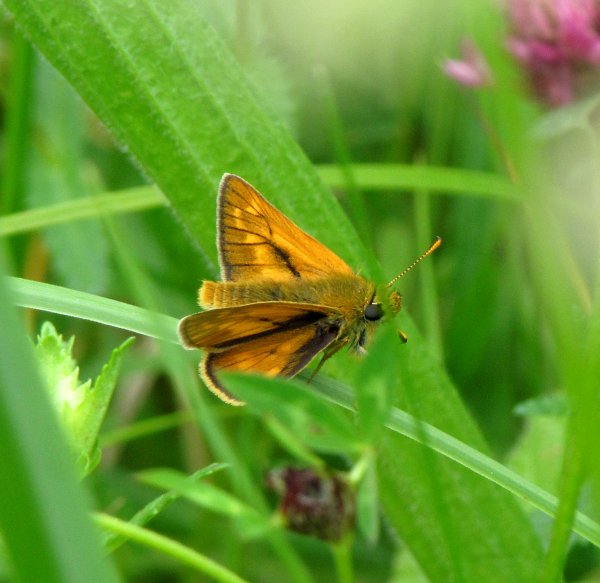
My trademark butterfly photo i.e. obscured by grass - a Large Skipper

A Silver-ground Carpet moth

 I managed to see eight Speckled Wood - this one is only a little bit grass-obscured

As you can see from the above collection, there were no Black Hairstreaks to be seen though I did get the consolation bonus of hearing a male Turtle Dove purring away in the woods as well as getting interested in another whole branch of insects!

This last weekend finally the first Black Hairstreak sightings started to be reported and with fine weather forecast for Monday I decided to have another go for them. This time I decided to try the mysteriously named M40 Compensation Area, a hidden Hairstreak hot-spot at the far side of Bernwood Forest which is full of Blackthorn which of course is the Black Hairstreaks larval food plant. It is a good half an hour to get to from the carpark during which there was not a great deal to see apart from a few damselflies by a little pond. Once in the area I spent some time wandering around staring at the top of the Blackthorn and was rewarded with several brief flight views and one prolonged view where I actually found the butterfly settled on the tree top though it flew before I was able to get a photo. Other butterflies seen were a Red Admiral, a Large White, several Meadow Browns, a couple of Marbled Whites, half a dozen Large Skippers and a Small Skipper. On the way back I met up with David Redhead, a local buttefly expert who suggested that in future in order to get the best views it's best to stake out the Privet flowers where they like to nectar - something to remember for next time.

Female Common Blue

Mating pair of Meadow Browns

I also found this gorgeous female Beautiful Demoiselle

What it was all about!


  As I didn't manage any photo myself, here are couple of cracking shots of a
Black Hairstreak taken by (c) Peter Law

I was most pleased to get my Black Hairstreak sighting though somewhat disappointed not to manage a photo myself. I have a vague plan to try to see all the Hairstreaks species this year. So far I've managed Green and Black. The hardest is going to be the White Letter which I'll try for next once they're in flight. Expect more posts on D&D's in the coming weeks and also moths (blame Badger for getting me into those!).

Wednesday, 13 June 2012

Otmoor Corncrake

However I look at it, I can't deny that it's June. My local patch at Port Meadow hasn't had anything good for some time now and all the birds that I'd be interested in on RBA are on the coast or at the other end of the country. The appalling weather meant that I couldn't even find solace in chasing butterflies and to be frank I was bored. Therefore a call from Peter Barker yesterday afternoon saying that the RSPB staff at Otmoor had found a calling Corncrake on Greenaways was a most welcome diversion. What's more it was at a convenient time and my VLW had no objection as long as I was back in time for her to go off and play tennis.

I arrived to find just Terry Tossell there but gradually other birders turned up with Peter Barker, Peter Law, Tom Wickens, Ewan Urquhart and some RSPB staff all there. Poor old Badger was up in Stroud but was heading back toute suite (he managed to hear it that evening). The bird was calling intermittently and like all Corncrakes it was very difficult to pin point. It sounded like it was a mere 30 yards in front of us but Tom went fifty yards along the path so that he could triangulate the source and he reckoned that it was actually much further away than we though being more like 100 yards away. Other birds seen whilst there was a Cuckoo (my first of the year amazingly), a Sparrowhawk, a couple of Redshank and the usual singing warblers. Anyway, as expected there was no chance of seeing the Corncrake but it was nice to listen to. In fact I spent longer there chatting to the other birders than I had intended and it was touch and go for me to arrive back in time for my VLW to head off though I did just make it.


This is all you get for a "heard only" bird


This does of course raise the issue of whether to count heard-only birds on one's county list. This has not been an issue for my Oxon list so far (I've even seen Quail) and we'd all prefer actually to see a bird rather than just hear it. However when presented with the dangling carrot of a Corncrake county tick I realised that I didn't have a problem with ticking it at all - funny that!

Wednesday, 30 May 2012

More Spring Butterflies

As discussed in my last post I'm turning to butterflies for solace during the lean summer months. I was particularly keen to catch up with some of the rarer spring butterflies and whilst I'd managed to see Dingy and Grizzled Skippers on my last visit I was still keen to catch up with Duke of Burgundy and Green Hairstreak and accordingly had been casting around for advice on this. The best site for Dukes seems to be Invinghoe Beacon between Tring and Dunstable but this is a bit of a trek from Oxford. However, Peter Law kindly pointed me in the direction of a small reserve where Dukes had been re-introduced recently and where he'd had some success last week. Accordingly with the weather forecast to deteriorate over the coming days I thought that I'd take advantage of the sunshine while I could and decided to have a go there today.


The reserve turned out to be a lovely relatively small patch of chalk grassland, full of wild flowers and grasses, with some small hawthorn bushes scattered about and bordered by woodland. On the bird front there were quite a few Red Kites flying around and I heard a calling Marsh Tit whilst I was there. I wandered about a bit before bumping into a more seasoned butterfly-er who managed to find a couple of Dukes for me. Whilst tramping  around on my own I also managed to find several Dingy and Grizzled Skippers, one Small Blue, one Common Blue and quite a few day-flying months including Burnet Companion and lots I didn't recognise. I was also delighted to stumble across a Green Hairstreak. For those readers who aren't already familiar with this species, it flies like a month (i.e. very fluttery) and looks dull brown on top but with the most amazing iridescent green underwing. As soon as it lands it turns its wings sideways to face the sun, presumably to gather the maximum warmth. They're not particularly rare though can be rather elusive and consequently tough to find.

After my poor photographic attempts last time I decided to concentrate on using the super-zoom and not to get too close as quite frankly the Canon's macro mode is a bit rubbish. The results look OK though none of them is your classic butterfly shot with either wings fully out or full side-on underwing shot and there are blades of grass etc. across the subject in a lot of cases. I actually think that this lends a much more natural look and greater interest to the shot than the classic pose though I expect that I'm just making excuses for my poor photographic ability! Anyway, I was pleased to catch up with these spring species, especially as it's getting rather late for them. Whilst chatting to the other 'fly-er he was telling me about all the places one could go to see the more exotic species and it's easy to see how one can get draw into this whole other world of butterfly chasing. I'm enjoying seeing stuff at present though I do still wonder about maintaining interest over a number of years after one has seen all the species. Time will tell.
 

Burnet Companion - the only moth there that I actually recognised!

Dingy Skipper with lots of grass in the way

The lovely iridescent Green Hairstreak


some non-classic Duke of Burgundy photos

Friday, 25 May 2012

Smells Like June Spirit

It's been such a strange birding year so far. The weather has been playing silly buggers, first being unseasonably hot, then unseasonably cold and wet and now we're back to Scorchio! again. This has really affected my local patch Port Meadow which is having its poorest year since I've started birding it in the autumn of 2007. Whilst the rain has meant that there's been plenty of water on the floods there's been hardly any wader passage to speak of apart from a few brief days when it was extra flooded. Also, I've not been able to find any grasshopper warblers when in a normal year I might expect at least 3 or 4 reeling males. Whilst it's still May it has a definite June feel to it and this has lead me to reach for my Summer Doldrums antidote of butterflies earlier than usual. I freely admit that butterflies are a poor second to birds as far as I'm concerned. I remember reading a while ago that birds are uniquely suited to the whole ticking off process because:

a) there are lots of them to count but not so many that one gets completely overwhelmed. Ticking UK mammals, for example, wouldn't really cut it because there just aren't enough of them

b) because of their mobility (they can fly you know) there's always the possibility of something really good turning up anywhere. Again with the mammals, once you've seen them all then that's it.


Butterflies on the other hand don't have that many species to chase after (I know one one person who saw all the UK species in a single year) and migrants are very thin on the ground. They do have one thing going for them though, which is that they are most active when the birding gets really quiet in June and July. Also, as I've only recently taken an interest in them there are quite a few species that I don't really know or haven't seen before so for at least a while I do get the satisfaction of seeing something new though this will realistically only last a year or two before I've seen all the local stuff. Actually, I've been meaning to go butterflying in May regardless of how good the birding was as there are some spring butterflies which fly during this month which I'd like to see. So today I decided to see if I could catch up with some of them and I chose to visit Aston Upthorpe Downs (or Juniper Valley as birders tend to know it) to look for Dingy and Grizzled Skippers, both classic spring butterflies that frequent chalk downlands. 

It was certainly hot enough (25+ degrees) though with a reasonable cooling breeze. My walk up the valley wasn't that productive and I only found a couple of Dingy Skippers, a Small Copper, a Common Blue and a few Cinnabar Moths. However on the return journey the wind dropped and suddenly there were Skippers everywhere. I spent some time trying to photograph them using macro mode on my point & shoot camera though the results are rather disappointing and little more than record shots. On the other hand the couple of shots that I took with the super-zoom have come out much better, so a lesson there for the future. I clearly need to work on my butterfly photographic skills though.

Here are the P&S record shots...

A rather ragged Cinnabar Moth
 
Dingy Skipper

Grizzled Skipper

Small Heath

...and here are the Super-zoom ones which were good enough to warrant the larger size...

Brimstone

Male Common Blue

I know that I can't really complain too much about the birding of late. After all in the last couple of weeks I've seen Squacco Heron and Cream-coloured Courser but especially with the Patch so off form it's nice to have an alternative local focus of interest during the lean months ahead. There will therefore no doubt be a few other butterfly posts forthcoming in the months ahead.