Thursday, 4 May 2017

Botanising on the Gower

As I mentioned in my previous post I've had a couple of trips still to write-up from my two outings to Swansea where Daughter 2 is studying. Now during the first trip at the start of April there was absolutely nothing worth stopping off for on the bird front and I was all set to give up and not bother stopping anywhere at all when I discovered that there is some rather good botanising to be had on the Gower peninsula. There's even a plant, Yellow Whitlow Grass, which in this country is only found along a ten mile stretch of the Gower coast line. What's more, Yellow Whitlow Grass flowers early, from March through to the end of April, so it would seem to be an ideal target for my trip. I'd only learnt about it at the last minute so I hadn't had time to do much research but it seemed to like Limestone cliffs and as (according to some last minute Googling) there'd been a guided walk to see it at Port Eynon on the peninsula I thought that I'd start there. I asked my daughter whether she wanted to be picked up first and come with me or whether she'd prefer to be picked up afterwards and she opted to tag along with me.

The weather was gorgeously sunny as we made our way along the roads leading to the Point. As I had no real idea where to go, I parked up at the main car park and then we just ambled along the shoreline as we headed south, looking for things of interest. We had our packed lunch on the beach before decided to head off towards the cliffs themselves. I had a hunch from what little I knew of Yellow Whitlow Grass that it might favour the cliff area and we even did some scrambling along the rather steep cliff face in our search for it but to no avail.

The Limestone cliffs at Port-Eynon Point

The Gorse-covered slopes
To be honest it didn't really matter too much that we couldn't find it. After all, I'd never even heard of this plant until the day before and there would be other opportunities to look for it after I'd had a chance to do more background research first. In the mean time there were lots of other plants to look at: nothing too out of the ordinary but I was just enjoying the beautiful weather and the great coastal scenery.


Alexanders

Common Dog Violet

Danish Scurygrass

Kidney Vetch

Marsham's Nomad Bee
Portland Spurge
Spring Squill
White Stonecrop
We spent quite some time rummaging around the plants in the area but eventually it was time to go so we headed back to the car, picking up ice creams at the local café before we drove back to Swansea and then onward toward home.

___________


The return leg was at the end of April and in the mean time I'd had a chance to do some research. It turned out that Yellow Whitlow Grass was most easily found at Pennard Castle, an old ruin on a spectacular cliff view-point, where it grew on the castle walls itself. In the days leading up to the trip there had actually been some bird action en route with, for example, some Black-winged Stilts at Slimbridge. However, all possible target birds had gone by the time my trip was scheduled so in the end I decided just to concentrate on going to Pennard Castle itself to see if I could find any of this plant still in flower.

This time my daughter wasn't interested in coming along so I dropped her off at her student house and then drove the relatively short distance to Parkmill. Here I turned off down a very bumpy single track road where I parked up near to the sandy dunes that make up the golf course and then walked the relatively short distance over to where the castle was located, taking snaps of any interesting flora on the way.

Wild Fennel

An old World War 2 water tower that's still standing at the side of the dunes
I think that this is actually a hybrid between Common and Sticky Storksbill

The ruins of Pennard Castle

The view from the castle was stunning - this photo doesn't really do it justice
There were loads of plants nestled in amongst the old castle stones. There were all the usual wall-loving plants apart from one which I realised from my research had to be the Yellow Whitlow Grass though it was no longer in flower


Maidenhair Spleenwort

Navelwort, just coming into flower
Rusty-back Fern
Wall-rue

Yellow Whitlow Grass, sadly no longer in flower
I spent some time rummage through all the plants that were growing in the walls. Finally on the last wall that I searched, a directly south-facing one, I found a couple of specimens of Yellow Whitlow Grass that were actually still in flower.


Yellow Whitlow Grass, still just in flower
Pleased with having found my target species I sat down to have my packed lunch and to enjoy the scenery though the weather was a bit more iffy than my last visit and it soon started to rain. This was my cue to leave so I headed back to the car and then back along the familiar M4 route towards Oxford.

Despite my prior misgivings, my two trips to the Gower had turned out to be rather enjoyable. No doubt as I get more clued up on the botany front I'll start to learn more what the local specialities are but at present I'm happy to wander around in a rather haphazard fashion, stumbling across various plants as I go. It's rather nice to have this botanical interest as another strand to my fascination in the natural world. It gives me yet another excuse to explore different parts of the country and to marvel at nature in all its forms. On a practical note, it also gives me something to do when there's no birdage to be had. There's a benefit to diversification!

Tuesday, 2 May 2017

More Local Birds for Local People

I've had a couple of  relatively local tripettes recently which I thought I'd combine into a single write-up.
 
Part I
The first one was last week when a singing male Wood Warbler was found at Spiceball Park in Banbury on the day that I was due to take Daughter II back to Swansea University (I'll write that trip up separately in due course). Fortunately this wasn't a county tick for me so I could watch from afar as things unfolded during the day. This species is seen annually in the county, often as a singing male found by a single observer as it passes through relatively quickly. Over the last few years however there have been more birds which have lingered long enough for them to be twitchable so it's definitely not the county rarity that it once was. Still it's a nice bird to see and given the dearth of decent local birds recently I did decide that should it stay a second day then I would pop over to take a look. The bird duly obliged and I kept true to my word, arriving at around 9 a.m. to park up in the familiar car park that I normally associate with visits to Grimsbury Reservoir just to the north of the park. In fact I'd not actually visited the park itself before and was pleasantly surprised to find a nice wildlife-friendly area with a river running through it and areas of grass left long to encourage wild flowers etc. The only fly in the ointment was the proximity to the motorway and the constant roar of traffic added a rather undesirable backtrack to the location. Anyway, I followed the path southwards along the river until I came to the first footbridge where I crossed over and entered the small copse with a wood-chip trail running through the centre of it. 

The Wood Warbler copse
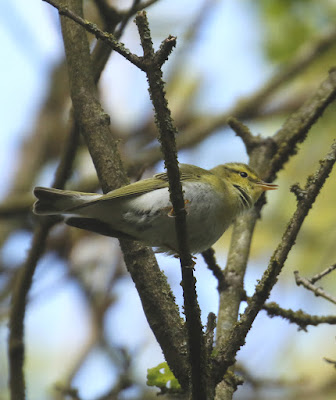
There I met a couple of birders who said that the bird itself had not actually been seen or heard during the twenty or so minutes that they'd been there though as I'd met some birders back at the car park who'd seen it well I wasn't too worried. I wandered around in the general area and after about 10 minutes I heard it singing well enough to home in on the general area where it was though I couldn't actually see it before it went quiet again. Another ten minutes passed before someone else spotted it up in the canopy and after that we were able to follow its rather sedate progress through the tree tops. Whilst Wood Warblers are superficially similar to Willow Warblers and Chiffchaffs, when studied at close quarters I was really struck by how different the shape was of this species. It was larger and rather rotund in appearance and it's very long primary projection meant that the tail looked short and stunted. The lemon yellow upper breast and supercilium were also quite distinctive compared to its commoner leaf warbler cousins. Altogether it was a very distinctive and smart bird.

The Wood Warbler courtesy of Ewan Urquhart - for more great photos see his write-up here

I watched it for some twenty minutes before it was lost to view and I decided that it was time to head home. I had a brief look at the flora on offer as I headed back but there was nothing of particular note, not that it stopped me taking a few photos.

Common Sorrel
Ragged Robin
Part II

On bank holiday Monday, I was just getting my head together at the start of the day when news broke on RBA of a Kentish Plover in Buckinghamshire. Now, regular readers will know that this is a bogey bird for me and  it was only recently that I'd dipped the bird at Pennington Marshes.The problem with this species is that it often doesn't linger very long. Time and time again one is found first thing in the morning only for it to move on a few hours later. Sometimes they can stay longer and indeed there have been a couple already this year in what seems like a good year for them, with one in Norfolk and another in Cornwall which both stayed several days. This is however very much against the norm and I realised that my best chance of seeing one was going to be if an inland bird turned up somewhere fairly nearby which I could get to relatively quickly. So when this news came up on the pager it was all systems go. I quickly got ready and within twenty minutes I was out the door and heading off towards Bucks in the Gnome-mobile. The bird was reported at Pitstone Reservoir which I'd not previously visited though I'd been to Wilstone Reservoir before and I knew that it was in that same general area. I'd looked up where it was before leaving and had programmed it into my Sat Nav and with the ETA showing as one hour after my departure I nervously negotiated the relatively slow roads that lead to Aylesbury and then onwards towards Tring. 

I arrived at what was obviously the right place judging by the numerous cars all parked up everywhere along the verge. I added mine to the collection, quickly got tooled up and hurried off along the path. I soon met some birders coming the other way who confirmed the bird's continued presence and told me that it was no more than a couple of hundred yards along the woodland path. I soon covered the distance where a quick hop over the fence revealed at least two dozen birders standing on a trampled area of nettles and looking down from what turned out to be a cliff-like vantage point towards the quarry lake and a large area of mud beyond that.


The Twitchers

Looking down from what was quite a high vantage point towards the mud area surrounding the large puddles where the Plover was
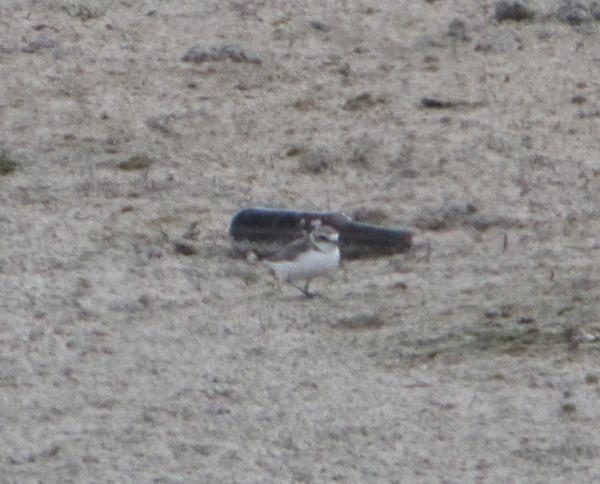
The bird was surprisingly difficult to locate and in the end I resorted to a quick peep through someone's scope to calm my nerves and secure the tick. After that I was able to find the bird in my own scope at my leisure myself and to set about taking some digiscoped shots though at this distance they were never going to be more than record shots.


The Kentish Plover
The bird was in a large open area of sand which it wandered over freely, periodically picking off some insect or other. There was also a Little Ringed Plover which occasionally would pick a fight with the Kentish though the latter never went far and just found a different area of sand to feed on. Most of the birders present there were locals judging by the main topic of conversation, namely which side of the Bucks, Herts county boundary the bird was on: apparently the boundary line went through the middle of the area where it was located so it wasn't at all easy to tell, though I personally didn't care either way. 

As my VLW and I had discussed an outing that afternoon I didn't linger long and having secured my tick and taken a few photos, within about twenty five minutes of first arriving I was heading back to the car and then retracing my way back home to Oxford where I arrived at a little after 11 a.m. As a point of interest, just over three hours after first having been reported the bird flew off not to be seen again, so once more confirming the typically hard-to-twitch nature of this species. It had well and truly been a Blitzkrieg twitch but thanks to my quick actions I'd finally got to see a Kentish Plover.


Friday, 28 April 2017

Out on the Wild and Windy Moors...

It was time to take Daughter 1 back up to Durham already. The Easter break is particularly short and it seems like I've no sooner brought her down then I'm slogging back up there again. I've also found from past experience that there often is precious little to see in the North East at this time of year and try as I might I couldn't really find much at all to tempt me. So this time, rather than heading off early in the morning to take advantage of as much birding time as possible, instead we didn't even leave Oxford until after lunch. Fortunately the traffic was very light and we even treated ourselves to a stop-off at a service station for a cup of tea to make for an even more easy-going journey northwards. We arrived in Durham some time after 6 p.m. and had soon ferried my daughter's stuff back into her student room. To keep things really simple we'd brought some micro-waved ready-meals for dinner which we ate whilst watching TV. Then, to save on the cost of paying for a B&B, she headed over to her boyfriend's so that I could sleep in her room on her comfortable bed. Before turning in I did some research on the day's bird sightings and the only thing of interest that I could come up with for the next day was a Great Grey Shrike a little way off the M1 (or so it looked according to the map) on the Yorkshire Moors. Now, normally I wouldn't go very far out of my way to see a Great Grey Shrike but it looked to be in rather interesting habitat that I don't get to visit so often so I resolved that unless anything better turned up, then I'd give that a go on the way back home.

Sunday dawned sunny and warm and with nothing else on the pager so far I headed back to the car and started my journey south. The roads were wonderfully clear and I made good time until I came to my turn-off for the Moors. However, what looked a relatively short distance on the map turned out to be further than I thought and it was a good hour of traveling along relatively slow roads before I neared my destination of Lower Barden Reservoir on Barden Moor.

Lower Barden Reservoir viewed from the car park
As I turned onto the narrow road that lead up to the top of the moors I spotted a Red Grouse sitting on a wall by the roadside. Excitedly I pulled over and took a photo with my phone. However, I soon discovered that actually Red Grouse were absolutely everywhere. There was another sitting on the wall right by the car park and they were calling and flying about where ever you looked. I got out of the car and got my stuff together and started down towards the reservoir.

Red Grouse were everywhere

Looking back up the hill towards the car park
As I wandered down the hillside I was amazed at just how much bird song there was. I'm used to moorlands being rather desolate and deserted places but this area was alive with singing. There were the strange clucks of the Grouse, then there were Meadow Pipits, Lapwing and Curlew all calling and singing away. Down by the farm there were Willow Warblers and Chiffchaff singing in the garden and a Snipe was drumming overhead continually. In the nearby field there were Redshank and more Lapwing, it was just full off life. I wandered about in a most contented manner, taking it all in.


An obliging Red Grouse

One of many Meadow Pipits

Green Hairstreak

Redshank

Golden Saxifrage
The only slight damper on proceedings was the lack of the Shrike. I met a local birder by the farm who pointed out where it should be but he hadn't seen it all morning so it rather looked like it had gone. I didn't really mind though as I was thoroughly enjoying the scenery and the moorland flora and fauna. The local chap told me that he'd seen some Ring Ouzels further out beyond the reservoir but that the best spot for them was right up at the top of the hill near where I'd parked so I decided to take a look back there instead. I wandered back up the hill to the car, partially in the company of a lovely and very chatty old couple who told me all about the local area and what could be seen. 

Back at the car it was only a minute's drive around to the car park at the top of the hill where I parked up and headed off to climb up to the summit. Right at the very top I managed to put up a Ring Ouzel that did a nice circular flight around me before headed over the brow of the hill and out of sight. Further round I found a singing male Cuckoo which posed long enough for some snaps.


Cuckoo
I ended up doing a complete circuit around the peak and finally as I headed back towards the car park I spotted a male Ring Ouzel, looking very much at home in amongst the rocks and boulders. It was rather distant but I took some super-zoom shots for the record.


Ring Ouzel
Back at the car I was rather surprised to see how late it was: it was after 2 pm and I was still more than three hours from home. Still with the radio to keep me company the time passed reasonably enough though as it was now Sunday afternoon the traffic wasn't as good as this morning. Finally I arrived back home late afternoon for my customary cup of tea and a chance to reflect on what had been a surprisingly enjoyable trip up to the North East.

Round-leaved Crowfoot that I found in a ditch
Some Climbing Corydalis, not yet in bloom

Monday, 24 April 2017

Pennington Marshes

I've noticed bird reports from time to time at Pennington or Keyhaven Marshes and each time I've had to look up where exactly there were, never having actually had cause to visit them before. Well, finally last week I had the opportunity to do so though the outcome wasn't as rewarding as I'd hoped. A Kentish Plover, a long-standing bogey bird for me, had been found at last light at the reserve and was still present at first light the next day. Now the trouble with this species is that it often doesn't hang around that long and it's staying can often depend on the tide. It was high tide at first light so there was a good chance as the tide fell the bird would move and may well not be relocated so this still wasn't enough to tempt me on its own. There was however a second factor in play which was that I hadn't been sleeping that well all week due to work-related stress. Having woken up in the middle of the night once more I resolved that I was going to stop the project that was stressing me out so much. This made me feel much better and I was able to get back to sleep after this. To help cement this change of tack I decided to take the day off from work altogether and so whilst I wouldn't normally have contemplated going for such an unsure twitch, this morning when it came up as "still present" at 9:30 I decided to have a go for it.

The journey down was fine though as I progressed on the familiar route south and then westwards along the M27 and with there being no further news on the pager, I did start to wonder what on earth I was doing and heavy melancholy settled over me that I was certainly wasting my time with this trip. Still, I was half way there already and it seemed silly to turn around now so I stiffened my resolve and soldiered on. There was a long delay at Lyndhurst where they seemed to be letting south-bound cars through only a few at a time but finally I was through and some two hours after having set off I arrived at the rather over-crowded small parking area to the north of the main reserve. Fortunately someone was leaving just as I arrived so I was able to park up. Predictably, on inquiry it turned out that the bird had last been seen some time ago when it had flown off. No matter, I was here now and I might as well have a look around so I got tooled up and headed off down the path.

My spirits were immediately lifted by the beauty of the location: there was lovely gorse in flower everywhere I looked with the whole area filled with bird song. Whitethroats were clearly "in" en masse with loads of them to be heard everywhere. I wandered along, feeling much more glad that I'd come now, looking and listening at all the signs of spring around me. About half way down the track I was stopped by a very distinctive and loud call that I didn't recognise. It sounded to me all the world like a large pipit call but not a Richard's (which sounds just like a sparrow). Could it be something like a Tawny Pipit? I looked carefully but there was no sign of the bird which sounded like it was no more than thirty yards away. Now, as I think about it now I really kick myself that I didn't do the following:
1) record the call on my phone (I'd stupidly left my super-zoom back at the car which is the best for this sort of thing)
2) wade in there to see if I could flush it.
3) stick it out a bit longer
Had I done all those things then I may well have got a shiny self-found Tawny Pipit tick to my name but as it was, I was preoccupied by the dangling carrot of the Kentish Plover so when the bird stopped calling I gave up after about five minutes and headed off. Doh! The next day a Tawny Pipit was seen briefly a few miles away at Farlington Marhes - perhaps "my" bird!

At the sea wall, there was no obvious twitch line scoping anything so I wandered along until I came to a few people looking quietly over the mud flats to the west of the Butts Lagoon.

Butts Lagoon
Here I met LGRE who'd also arrived too late to see the bird but was still keen to get it on his year list. All the small waders seemed to be feeding out on these mud flats so we scoped together but there was no sign of it. Apparently the Kentish had been keeping to itself this morning anyway so it may well have been off on its own but it certainly wasn't with these other birds. There was a nice collection of waders though with Grey Plover, Turnstone, Knot, Dunlin, Ringed Plover, Curlew and Whimbrel all to be seen. Another birder reported that a Curlew Sandpiper and a Spotted Redshank were to be had further west along the sea wall so after a while LGRE, another birder and myself all headed off to take a look. The Curlew Sandpiper was in the middle of Fishtail Lagoon though rather distant. As you don't get to see this species every day (especially in Oxfordshire) I took a few digiscoped photos for the record.
 
Curlew Sandpiper
Further over on the same pool we found the Spotted Redshank, which was closer so I took a few more shots.


Spotted Redshank
We wandered as far as Keyhaven Lagoon where there was another Spotted Redshank in full summer plumage though it was very distant. Here there were a few Godwits and a single sleeping Greenshank, again rather distant.

Keyhaven Lagoon
All the while we kept looking out for the Kentish Plover on the mud flats but we could see precious few waders from this side. A distant calling Cuckoo was my first of the year though we couldn't see it. After a while we decided to head back to where we'd originally been looking. Whilst the other two hurried back, I took my time, taking in the spring sights and enjoying seeing all the waders on these wonderful pools that they had at this reserve. I also kept an eye out for any interesting flora though there wasn't actually that much on show. A few things caught my eye though.
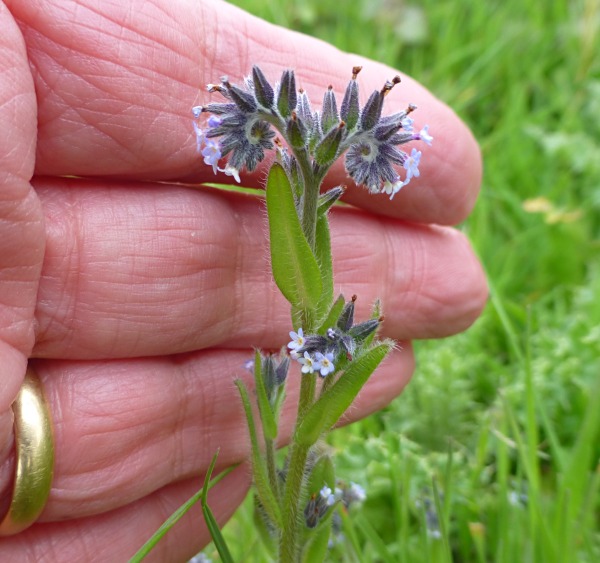

Changing Forget-me-not - I love the coiled flower stems of this species

Germander Speedwell

Sheep's Sorrel

Sun Spurge
Back at the original watch point we all had another scan through though without turning up anything new. LGRE and his companion decided to head off to look for a Hoopoe that had turned up in Sussex whilst I decided to stay on a bit longer. I ducked down on the leeward side of the sea wall to eat my packed lunch out of the increasingly chilly wind. I met a lady who said that she'd seen some Bearded Tits though I couldn't see or hear any myself during my lunch break. I went back to scoping the mud flats in the company of just a single remaining birder.

After a while I decided to explore the other end of the reserve whilst I was here. I wandered along the sea wall, past the shingle spit where the bird had roosted at high tide. A Little Tern went by on the sea and there was the usual mix of waders on the various pools that were dotted about the place. I got good views of a Marsh Harrier as it quartered the scrub inland of the pools. Eventually, with time marching on I headed back along the path to car. All in all I was very much taken with what had turned out to be a lovely reserve and despite dipping my target bird I was pleased that I had come. If nothing else this day out had been the perfect antidote to my work stresses and I very much look forward to a return visit at some point in the near future.