Saturday, 11 June 2016

Strumpshaw Fen

In my quest to finish off my UK butterfly list this year I'd been keeping a keen eye on the Strumpshaw Fen web-site recent sightings page. The spectacular Swallowtail butterfly is pretty much only found at Strumpshaw and is therefore one of the must-visit locations for anyone who is keen to see all the resident UK species. According to the updates, the start of the warm weather this week had brought out all the Swallowtails which were being seen regularly every day - they were even being seen in the nectar garden right outside the reception area. With the weather forecast to break by the end of the week I realised that I needed to act quickly and so it was that this Thursday I made the three hour pilgrimage in the Gnome mobile eastwards to just outside Norwich to pay homage to this most exotic of butterflies.

The weather was forecast to be cloudy all morning but to clear for the afternoon so I didn't bother leaving too early but instead set off sometime around 9:30 a.m., opting for the usual A43/A45/A14 route towards East Anglia. The journey itself was uneventful though it seemed to drag on for far too long. Fortunately the weather behaved as predicted and the rather overcast conditions had just given way to full-on sunshine as I pulled up at the heaving car park. Indeed it was so full that an RSPB volunteer stationed there was suggesting that I use the back-up car park which was 1km's walk away. Having just driven all that way I wasn't going to be told that I had to park miles away and walk back and was all set to go and  indulge in some nearby "creative" parking instead when someone came back to their car right outside the reserve and headed off so I was able to park up and get ready. Then it was just a matter of walking across the railway line to the reception area at the entrance to the reserve.


The Reception Area

On arrival I could already seen several people pointing lenses at the bank of flowers in a raised bed right in front of reception and sure enough there was an immaculate Swallowtail feeding away frantically on the flowers. It was all so easy! I busied myself with taking some snaps though the ultra bright conditions and the fact that the butterfly was moving ceaselessly meant that it wasn't that easy to get a decent pose but I got some reasonable shots in the end. I was very thankful that all the pressure of finding a Swallowtail on this trip had been removed so quickly and that I was now free to go and look for some bonus insects and flowers.
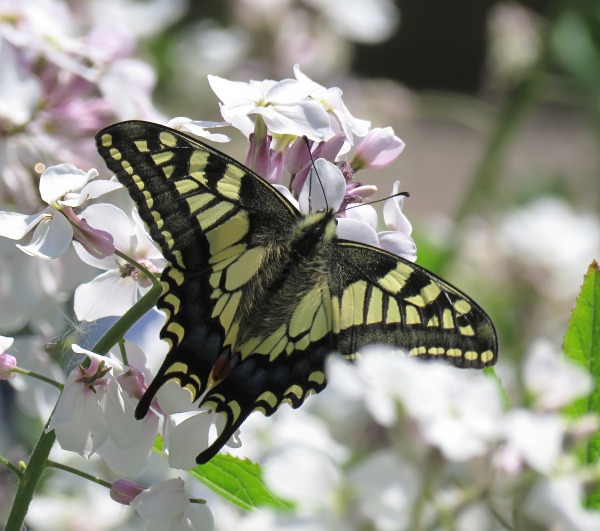


A very convenient Swallowtail right outside the reception area
I popped into the reception to ask about where the best place was to see the East Anglia dragonfly specialities, namely Norfolk Hawker and Scarce Chaser, both of which, according to the blog, were on the wing now. I was told that the Meadow Trail and the Fen Trail would both be good spots for them and noted this down on a map. I then asked about the location of the Common Twayblade orchid which I'd read on some blog were located near the reception area. The receptionist didn't know though she did mention that there were some Bee Orchids just by the entrance gate. She decided to head off to the main office to ask someone so in the mean time I headed back to the car to pick up my packed lunch and to see if I could find the Bee Orchids. These turned out to be easy enough and I soon found one right underneath the main reserve sign.

Bee Orchid
Whilst I was in the reception area it also turned out that there was several Hawkmoths dotted around the place on the various walls - presumably the fruits of a successful trapping the previous night. I busied myself with taking some snaps: there was one Elephant, a couple of Poplar and a couple of Eyed, the latter actually being a personal moth tick.

Elephant Hawkmoth
Eyed Hawkmoth
Poplar Hawkmoth
I returned to reception where the lady was now able to tell me where the Twayblade were - no more than 30 metres from where we were standing though tucked away under a tree and so easily missed if you didn't know that they were there. I wandered over and soon found some.

Common Twayblade
So that was one Swallowtail, 6 Hawkmoths and two different Orchid species all within a few yards of each other - most impressive! Having mopped up on everything I headed off towards the Meadow Trail to see if I could finally get to see the two speciality large dragonflies.


The Meadow Trail

The path lead down through a wooded area before opening out onto a clearing where a few people were watching another Swallowtail which was flitting about actively and rather high up in a tree. Given the great views that I'd already had a point blank range by the reception area, I didn't hang around but headed onwards. After only a few minutes walk the path opened out onto the Meadow Trail. This was a wonderful open flood meadow criss-crossed with slow flowing drainage ditches a few metres wide and lined along the borders with what were still rather low reaching reeds and sedge. The surrounding meadow area was a riot of colourful flowers and sedges and there were plenty of dragonflies patrolling the ditches. Willow Warblers were warbling their melancholy cascade and I could hear distant Reed and Sedge Warblers singing away from the nearby reedbed. In the brilliant sunshine it was a wonderfully pastoral scene that nourished my soul as well as got me salivating at the prospect of routing out some interesting dragonflies. All in all it was pure heaven for an odonata enthusiast such as myself.

The start of the Meadow Trail area
These ditches are where the dragonflies hang out
To start with it was just Four-spotted Chasers and Hairy Hawkers that I was coming across as I worked my was slowly along the path.

Four-spotted Chaser
Turning the corner by a small wooden footbridge I started to search the next ditch where I soon spotted a large brown-coloured Hawker patrolling the area. A quick look in my bins: clear untinted wings, no markings on the side of the body and nice green eyes - yes, it was a Norfolk Hawker! Fortunately it settled briefly and I was able to get a shot.

A Norfolk Hawker
I was very pleased to have seen one of my target dragonflies relatively straight-forwardly though despite scouring the rest of the ditches along the trail carefully all I could unearth was one more Norfolk along with numerous Hairies and Four-spots and there was no sign of any Scarce Chasers.

Another Four-spot
There were loads of interesting plants to view whilst I was in the Meadow Trail and I took lots of photos as I went along. As a relatively newbie botanist I didn't immediately recognise all of them so it was great to have a good rummage around to see what I could find.

Southern Marsh Orchid

Marsh Valerian

Bogbean

Marsh Thistle
I had a chat with a fellow dragonfly enthusiast whilst I was there and he helpfully told me that the Scarce Chasers were usually to be found along the river over on the Fen Trail side and now that he mentioned it, I did recall reading how they were more of a riparian species so I decided next to head off in that direction along the river


The Fen Trail

I'd adored the Meadow Trail with it's open views, narrow ditches and wonderful wild flowers. By contrast, walking along the river (which was looking rather swollen and fast-running) was not nearly as enjoyable. The bankside vegetation was much taller and it was consequently harder to see anything. To start with there was little of note apart from the odd Banded Demoiselle but as I headed further along the river I started to come across some small bays where there were inlets from the river into the water complex on the other side of the bank. There were sluices there so the RSPB could presumably control the water levels on the fen side to ensure optimal conditions at all times. It was in these bay areas that I first came across my quarry when I spotted a teneral Scarce Chaser posing on a branch in amongst the vegetation. Unfortunately I was looking into the sun and it was facing the wrong way but I could see all the tell-tale diagnostic features of dark patch at base of lower wing, yellow veins in lower wing and grey-blue upper eyes that all told me that I was watching my first ever Scarce Chaser.

Teneral Scarce Chaser - shame it's facing the wrong way!
Further along I chanced upon a mating pair in another bay area.

Mating pair of Scarce Chasers
In yet another bay I managed to get my best views so far of yet another of these interesting dragonflies. So that was at least four Scarce Chasers seen along the river section with several more fly-overs that were "probables".

Another teneral Scarce Chaser
I've not mentioned birds at all so far along this stretch but I did manage to see a couple of Marsh Harriers and a Hobby soaring over the central area of the reserve and all long the river bank there were Whitethroats, Blackcaps and Cetti's Warblers singing away. I stopped to eat my sandwich and gave my VLW a call to see how she was - apparently all was OK back at base. I then followed the path further along the river until it turned inwards along a wide, well-mown path following a small river. I was expecting to see more dragonflies as I walked along this bit though sadly I only saw one brief unidentified fly-over on this entire section. I did get another Swallowtail sighting as one flew over the path but that was it.

Eventually the path turned back towards the direction of the reception area and I came across a boardwalk detour right into the heart of the reedbed. The idea of this was to give you an idea of what went on in the middle of the reeds and I must say that it was really great. For a start I finally came across some Milk Parsley - the larval foodplant for the Swallowtail butterfly and the reason why they colonise Strumpshaw Fen. The Parsley wasn't in flower yet but the leaves were quite unmistakable.

Milk Parsley - the Swallotail larval foodplant
I also came across the strikingly-coloured Marsh Cinquefoil, a really stunning plant and much larger than the usual yellow Cinquefoils that one comes across. Then it was back along the boardwalk to the end of the trail where the path crossed over the railway line and lead to the end of Tinkers Lane.

Marsh Cinquefoil
Common Meadow-rue

Tinkers Lane

At the end of Tinkers Lane there was the famous "Doctors House" where a retired lepidoptera-loving doctor and his wife lived. They'd planted a fantastic nectar-rich flower bed at the front of their house that was buzzing with all sorts of insects and which Swallowtails apparently regularly visited. The couple very kindly allowed open access to the flowers so that people could see the butterflies at close quarters. In fact, it was generally understood that it was the best place to see this species on the reserve and had I not seen the one at the reception area so well then I too would have come here first of all.

The famous Doctor's House
I had a wander up the path and there was indeed a single Swallowtail feeding frantically at the top of the flower bed. I tried taking some photos but it was moving about so rapidly that in the end I gave up and just took some video instead. 


Having had my fill I started to wander back along the lane. I'd only gone a short distance when I spotted a group of photographers all gathered around one spot and papping away like fury. I came over to see what they were looking at and it turned out to be a single pristine Swallowtail settled on the top of a tall grass stem and feeding away avidly. I was somewhat surprised as grass isn't know for its nectar but the butterfly seemed happy enough and what's more it was posing perfectly with only a bit of a breeze that had sprung up troubling what would otherwise have been an easy photographic opportunity. Still in between the swaying I managed a photo that I was pleased with.

A perfectly posing Swallowtail

Greater Stitchwort, growing along the lane
Then I ambled back along the lane towards the reception area where I treated myself to a nice cup of tea and a flapjack which I enjoyed whilst sitting in the shade near the Common Twayblade and contemplating what had been a most successful visit. Still, time was marching on so I finished my tea and headed back onto the roads. The journey back took a little longer as I hit a traffic jam on the A14 and in the end decided to go back on the A428 via Bedford and Milton Keynes instead which at least made for a bit of variety. Still, it couldn't spoil what had been a really great day out with lots of really interesting insects and plants and I was now one step closer to completing my UK butterfly list.


Monday, 6 June 2016

Downy Emeralds

With the coming of June I'm now firmly in summer mode which means flowers and insects. With this in mind when I saw reports of one or more Downy Emeralds dragonflies just down the road in Abingdon at Barton Fields NR it very much piqued my interest. Now, as part of my quest to tick off all the UK dragonfly species I'd already seen Downy Emerald before at Warren Heath (see here for write-up). However it had only been a brief view and I'd never seen on in Oxfordshire before (not that I do a county odonata list) so it seemed rude not to pop down and pay it a visit. Of course the weather has been far from ideal for insects so far with a remarkably cold wind and low cloud making it feel anything but like June but this Sunday suddenly the weather flipped into warm mode and it was forecast to be warm and sunny all week. Needing no further excuse, after lunch I went on the short trip down to Abingdon with my (now nearly ten year old) son L in tow to see what we could find.

I'd visited this location last year (see here) to see the Variable Damselflies that had been newly discovered there so I knew the layout already and soon we were turning off the main path towards the small narrow lake that adjoins the Thames here. I scoured the area where the Variables were last year but then it had been very wet and flooded and in the one hot spot there had been loads of them. This time, it was dry and I didn't see a single damselfly at all. Not to worry, they weren't the main target today and we made our way on to the lake itself.

It didn't take us long to find our quarry: we worked our way along the lake stopping at each opening in the vegetation (which I think had been cut out for fishing purposes) and towards the eastern end we had our first views of a shiny Downy Emerald as it came up and patrolled the gap in the reeds before it shot off elsewhere again. We then passed a very pleasant hour and a half working our way along the bank looking out for occasional views of the Downy Emerald as well as the odd Hairy Dragonfly and a stubby little Four-spotted Chaser. In addition there were moderate numbers of Azure, Common Blue and Blue-tailed Damselflies along the bank and out in the middle I could see quite a few Red-eyed Damselflies patrolling low over the water. We also spotted a large bat (a Noctule?) flying around over the lake in broad daylight - very strange! L amused himself with my point-and-shoot macro camera taking lots of photos of the various bugs that he found whilst I tried in vain to get a photo of the Downy Emerald - a species which is notorious for rarely settling.

Azure Damselfly
Black-headed Cardinal Beetle
We eventually homed in on a hot spot right at the eastern end where a large flat piece of wood had been laid out in the reeds to make a sort of platform. Here we saw that there were in fact two Downy Emeralds and we had lots of fun trying to get a flight shot though my bridge camera is particularly bad at this so in the end I resorted to video and managed a record-shot grab of one in flight.

Video grab of a Downy Emerald in flight
Eventually one of the Downies headed over to a nearby tree where, miracle of miracles, it did actually settle briefly and I managed a record shot of it though it was rather distant.

Settled in a tree

After a while L started to get tired and so we headed back to the car and on the way home we stopped off for ice cream before returning to Casa Gnome where I rewarded myself with a nice cup of tea.


These days I never miss an opportunity to learn more about any interesting flora I might spot. Apparently this is Reed Canary-Grass (with some Greater Pond Sedge in amongst it)

Welted Thistle
Hairy Tare

Wednesday, 1 June 2016

Hartslock Orchids

Regular readers may have noticed a distinct lack of posting on my front of late. This hasn't been how I intended it to be but a combination of work commitments and my VLW being unwell has meant that I've not been free to head out on my usual birding sorties as I would have hoped during the normally-productive month of May. Having said that, there haven't been that many opportunities that have fitted my trip criteria: nothing has been reasonably close that has looked fairly settled and twitchable apart from the Caspian Stonechat at Titchfield and the Kentish Plover up at Manchester, both of wish I regret not going for but sadly I just wasn't able to get away.

So now here we are in June already and the on-set of the summer birding doldrums. Actually for me this is a rather busy time of the year as I pursue my summer interests of butterflies, moths, odonata and also these days flowers. In fact I seem to be taking the latter more seriously this season and have been trying to get my head around some of the more tricky local common species. Anyway, with my increased interest I've been reading up on what's of interest within the county and have of course come across all the goodies that are on offer at the Hartslock BBOWT reserve, chief of which are the rare Monkey Orchids that are only found there and in a couple of places in Kent. Therefore, as it was the prime time to go and see them I proposed a family outing there this last weekend and so this is what we did. With no parking at the reserve at all we parked in Goring and walked along the river (stopping to check for Club-tailed Dargonflies at the railway bridge but no luck during the brief time we were there) before heading inland and up to the reserve.

For those who've not been before it's a relatively small steep chalk escarpment overlooking the Thames valley. The views are great and there's lots of wonderful specialist flowers to keep a newbie botanist such as myself interested for hours. Not that I had hours as the rest of the family quickly grew rather restless but I had enough time to rummage around the plants and to take plenty of photos before we headed back to the car. We were very lucky with the weather and for once it was sunny, warm and not too windy. It's a great little reserve and one which I can thoroughly recommend.

The view from the reserve looking back towards the famous (for dragonfly hunters)Goring railway bridge

There was lots of this gorgeous little Chalk Milkwort about everywhere

We even found a nice Green Hairstreak, one of my favourite butterflies


The rare Monkey Orchid
Hartslock is unique in that it's the only location where the Monkey Orchids have hybridised with the Lady Orchids there. This hybrid is now flourishing as you can see from the photo above and greatly outnumbers both of it's original parent species
Close-up of the Monkey x Lady Hybrid
A mixture of Chalk and Common Milkwort


Monday, 2 May 2016

Durham Debacle

It was time to take Daughter 1 back up to Durham again for the start of her summer term. It's amazing how we're coming up to the end of her second year already - the time has just flown by. Anyway, as usual I'd been casting around for something interesting to see but in mid April in the North East there is precious little of interest. In fact, this time last year I decided to head on up to Scotland because there was so little on offer in the region. In the end this time I almost couldn't be bothered to try for anything and had suggested to my daughter that she might like to take the train instead but it turned out that she'd brought down too much stuff to do this so I resigned myself to another slog up north. To complicate matters further Daughter 2 had her martial arts (black belt!) exam that morning so we weren't going to be able to set off until the early afternoon anyway and there wasn't going to be as much time for birding as I'd usually have. In the end I decided that I would play it by ear and if nothing new came up then I'd drop in on the Iberian Chiffchaff at Telford on Sunday morning as it wasn't too far off off route though I'd already seen a couple here in the UK and quite frankly I was finding it difficult to summon up much enthusiasm for it. Things rather changed however on the night before our departure when news broke of a Broad-billed Sandpiper in Gwent near Newport. Now, it's hard to think of Gwent as being en route in any shape or form but my interest was certainly piqued. However, by the time we were due to head off on Saturday it was "no further sign" as it had flown out with all the other birds onto the estuary there. So unless it re-appeared again at the next high tide that evening then it was fairly academic anyway.

That morning, before taking Daughter 2 off for her grading, we got news from our housekeeper down in Cornwall that our neighbour there had taken it into his head to cut down one of our large trees in our garden. We were devastated and couldn't believe what he had done, it was so upsetting. There was no time to dwell on it now however as we had to get on. Anyway, Daughter 2 passed her exam (hurrah!) and Daughter 1 and I set off on the long slog northwards. I'd been suffering a bit from waking up too early the last few weeks so was feeling a little bit sleep-deprived but I found that this quietened my mind sufficiently to stave off the boredom of the long journey and the time passed surprisingly quickly. During the trip I kept my eye on RBA though there was nothing of note at all to sway me towards any particular plan. We duly arrived and unpacked the car and I settled down with a cup of tea to contemplate what to do next. My current thinking was to head back south and find a hotel not too far from Telford so that I could pass the next morning with the Iberian Chiffchaff as planned before heading on back home. 

Just as I was coming to the end of my tea news broke that the Broad-billed Sandpiper was back at Gwent. "Hmm, that could be a game changer" I thought and started to hatch what was quite frankly a crazy plan. I started to think about heading back down south, staying overnight in a hotel within striking distance of Newport and to head on there for around about 7 a.m. Since high tide wasn't until after 9 a.m. the bird should with any luck roost on it's favoured island once more enabling me to score on what would be a pretty epic twitch. I don't know if it was the lack of sleep which was fogging my mind but somehow this seemed a reasonable plan so I bade my daughter goodbye and headed back on the road again.

On the way back south I got a call from the Wickster (on the hands-free) who'd found a Wood Warbler at Farmoor, a good bird for the county of Oxfordshire. I told him of the county birders who I thought still needed it for their county lists and at the next petrol station I stopped to put the word out, this duty falling to me in the absence of Badger who normally does the honours. That done (fortunately I didn't need Oxon Wood Warbler myself) I resumed my journey and tried not to get too freaked out by the stupidity of what I was attempting. As darkness fell, I turned off onto the A42 and stopped in a layby to plan where to stay. In the end I picked a hotel in Droitwich, booked it via my phone, put the address into the Sat Nav and headed onwards. I arrived there at around 9 p.m. only to discover that they were having a wedding reception there and that there was loud music and revelry in all directions. There then followed a Goldilocks-style room debacle whereby in the first room the heating was stuck full on and was unbearably hot, the second room had some enormous fan running directly underneath it and vibrating the whole floor and finally the third room was tucked right away in the far corner of the hotel so I couldn't hear any noise and was otherwise fine. I gave my VLW a call to find that she'd had a really rough day and couldn't stop thinking about our Cornish garden. Having her so upset and not being able to do anything about it was most stressful and this, coupled with all the driving, the stress of changing rooms and the fact that I was going to have to get up insanely early and really needed to rest all left me far too wound up to sleep. So in the end I headed down to the bar and ordered a triple whisky before going for a walk in the grounds to calm down. This did the trick and back in my room I was soon asleep.

I woke up at 4 a.m. to the sound of a blackbird singing right outside my window, welcoming the first hints of dawn. This was earlier than I'd wanted but I had a quick shower and headed off onto the deserted streets before 5 a.m. The journey southwards was uneventful though I took it steady as I'd had so little sleep. I arrived shortly before 7 a.m. to find a long line of cars along the road. Parking up, I hurried along to the first hide and stood before the door. This is what it all boiled down to: all this effort would either stand or fall according to what I found on the other side of the door. Which would it be?

The view from the hide of the first island
Sadly, it was not to be. There was no sign of the bird roosting in amongst the fifty plus Dunlin there though occasionally more birds were flying in so for a while there was a bit of interest still. I amused myself with a few year ticks in the form of Wheatear, Greenshank and Knot and went to try the other hide for a different perspective but in the end it was just a massive dip.

roosting Avocets and Dunlin
A clump of Cuckoo Flower

There was lots of the highly poisonous Hemlock Water-dropwort along the stream though it was not yet in flower

By way of a break from not seeing a Broad-billed Sandpiper I took a small detour to the RSPB centre at Newport Wetlands (to use the toilets there) where I got Reed Warbler and Lesser Whitethroat as additional year ticks and returned to Goldcliff to find no change in the situation. Finally at around 10 a.m. I climbed back into the Gnome mobile and headed for home. As I drove I contemplated the frustration of the weekend. Still, I wasn't going to see birds like Broad-billed Sandpiper by sitting at home in Oxford and the only consolation was the the Iberian Chiffchaff wasn't seen all morning at Telford either so I'd have dipped had I gone for that anyway. By now I was frankly too tired to care and just wanted to get back home and so I carefully guided the car back on what was thankfully an uneventful journey. Had it all worked out, it would have been a heroic effort duly rewarded but as it was, it was just a really stressful and tiring weekend with little to show for it other than my daughter safely back at her university. Sometimes birding can be a really frustrating hobby!

Thursday, 28 April 2016

Iffley Meadows

A few weekends ago we went on a Sunday afternoon ramble en famille to Iffley Meadows to pay homage to the Snakes-head Fritillaries that were then in full flower. In all these years that I've been in Oxford, I've only been to Iffley Meadows a few times and never in April when the Fritillaries are in bloom so it was about time that this was put straight.

It was far boggier than some members of the family were expecting so there was a certain amount of complaining from some quarters but everyone agreed that the flowers themselves were very striking. Unfortunately, conditions were rather overcast and I've had to tweak the photos a little to add some colour to them. Afterwards, as a reward for traipsing through the marsh we had tea at the local hotel by the river.


Some bonus Cornsalad

Wednesday, 20 April 2016

Wytham Wood in Early Spring

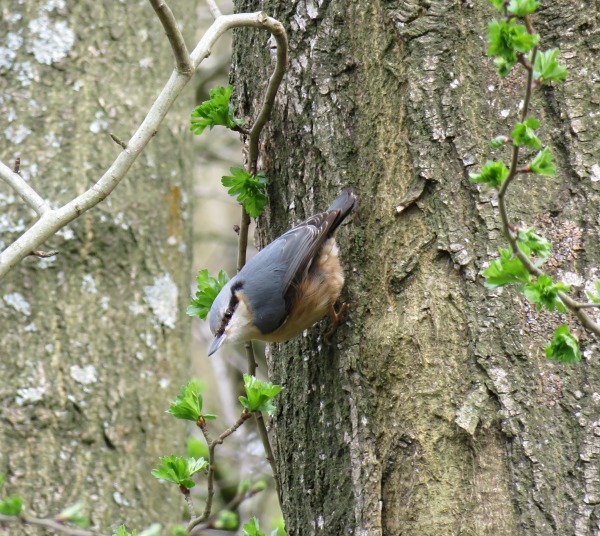
We went on a family walk on Sunday afternoon last week to Wytham Wood. It was wonderfully understated with the Bluebells just starting to come up and leaves just starting to appear on the trees and with everything still promising much but yet to deliver. As we wandered I snapped various flowers and birds though there wasn't much of the latter to be seen or even heard and a single Nuthatch was the only bird I actually saw close up. I was quite keen to see or at least hear a Marsh Tit as this is a great area for them but I had no luck today. Still it was a very pleasant afternoon stroll en famille with a light smattering of nature to boot.

The Bluebells are just starting to come through now
Dog's Mercury

Early Dog Violet


The one bird

Wood Anemone - all these years I've been ms-pronouncing it "Anenome" until I finally looked it up!