Sunday, 13 February 2022

Eastbourne American Robin

This week Twitter and the blogosphere have been awash with pictures and stories about the star American Robin that was found late on Tuesday afternoon in a rather unlikely suburban location on the outskirts of Eastbourne in East Sussex. There was good reason for such intense interest: there have only been 28 previous records in total and the last mainland twitchable one was down in Devon on the Exminster Marshes all the way back in 2010. So a proper Mega then! Certainly it was something that I'd not seen previously and as it was only about two and a half hours drive away it fullfilled all my criteria for a day out. 

Whilst really hardcore twitchers were going to be there at first light the next day, I generally like to wait a little while for the crowds to die down a bit. Not that I was in position to drop anything anyway: I had a full-time job to do so it was either a matter of waiting until the weekend or I would have to arrange a day off which would require at least some reasonable notice for my manager. In the end I decided that the first weekend after discovery would be far too crowded so opted for taking Friday off instead and to head off on news. The latter dropped just after 7 a.m. and I was off by 8. The journey there took pretty much the predicted two and a half hours though the last bit from Brighton onwards was longer and more tedious than I had expected. Still I passed the time in the company of Radio 4 and at around 10:30 I found myself turning off into some rather narrow sideroads that lead up the hill towards the aptly named Hill Road. I parked up at some distance from the main twitch location and hurried towards the assembled crowd. 

Staking out a berry bush (off screen on the right)

There were about forty birders present in the end area of the cul-de-sac by the garages. Judging by the relaxed atmosphere the bird currently wasn't on show which was soon confirmed on asking a fellow twitcher. There seemed to be two groups of photographers camped out in front of some likely looking berry bushes so I set myself up by the further group and looked around me. The surrounding houses were nestled tightly on the rather steep hillside and surrounded on two sides by woodland. With not a breath of wind and surprisingly strong sunshine it was a truly lovely day, altogether different from what I had been expecting that morning when I was preparing. In fact I was beginning to wish that had put some sun cream on!

The garages with one berry bush on the left-hand end

One of the key themes of the day was about reading the crowd. I soon noticed that the photographers near me had suddenly gone into alert mode and were staring intently at the bush in front of us, fortunately the one that I had chosen to stand near to. After initially just seeing some movement from deep within, suddenly our star bird came out into the open on the bush and started eating the berries. This was a cue for some frenzied papping and I duly joined in with my superzoom, managing some shots that, as a blogger rather than a photographer, I was more than happy with. 


Yet more American Robin photos - just what the internet needs!

After a little while the bird flew off a short distance and dropped down behind the garages out of sight. A few minutes later and it flew low across the road down into a small garden just on the edge of the garage area where the ground sloped down steeply to a heavily laden berry bush. Birders near to this area soon crowded around the fence, peering in and trying to get a view. I had a brief peep but it was too crowded for my taste and the views were so poor that there seemed little point in making an effort. So instead I went back to the main square and waiting to see where it would go next. 

After some twenty minutes or so it flew low over us all and out onto the steep slopes beyond the houses. Here there was a small clump of trees and bushes including a single tall bare tree that I recognised from internet photos. However, rather than sitting there the bird instead dropped onto the ground and out of sight. There then followed a long period of frustrating waiting for it to show. It was periodically on view for some people at some angles. Again, it was a question of reading the crowd and I soon spotted that a couple of people down at the end of a side path could see it so I joined them, gaining some brief views of it on the ground through some branches before it moved too much for the angle to work any more. After that there was a long period of not seeing it at all.

The kind of obscured view that you more often associate with a crippling mega
rather than the previous porn shots

Time passed and gradually numbers swelled as more people arrived and the lack of recent decent views meant that fewer people were leaving. PL, a fellow Oxon birder, turned up. I'd been half expecting him today: we tend to have similar twitching criteria and need the same species so we often meet up on twitches. I brought him up to speed on events and fortunately within a few minutes of his arrival I again noticed that some people seemed to be on it. I picked it out on the ground in the field in a large gap to the right of the main bushes where it was working its was to the right and I managed to get PL onto it. After that, from watching the crowd it was periodically showing at certain angles but I didn't see it again. Not that I minded: I'd had crippling views to start with plus a number of "record shot views" to follow and felt it was time to move on.

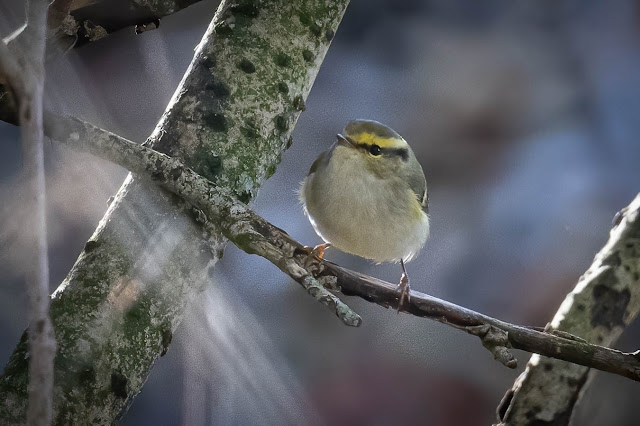
Anyone who has been following the multitude of Eastbourne blog posts will no doubt already know about what else was on offer. There was of course the long-staying Hume's Warbler down on the seafront which was next on my itinary. I'd only ever seen one Hume's before, in November 2011 at Wyke Regis in Dorset where I'd managed to rock up on the way back from Cornwall and see it within a few minutes of arriving. So there was no pressure on this next target but it would still be nice to see as I am very partial to a nice phyllosc. I duly programmed up the Sat Nav and after a hiccup where it secretly changed the destination (I have to figure out why Google Maps does this occasionally) I turned up at the right spot and found a parking space right opposite the twitch. The last RBA instructions had said that it was along the lower promenade on the sea front but clearly the line of birders up one side of a small park-like square said otherwise and I hurried to join them in staring up at the canopy of some Holme Oaks. There I met NT (another Oxon birder) and his wife who told me that it was feeding along this side but was only giving occasional glimpses.


The Hume's twitch. Numbers more than doubled during the time I was there

Once again it was a question of reading the other birders to see where it was. The two birders at the top of the side road seemed to be raising their bins most frequently though often I could barely even see the movement that they were homing in on. It was certainly tough going. After some 15 minutes or so the bird popped out briefly at the top of the tree and I got some brief flight views though to be honest I couldn't tell it was a Hume's from what I'd seen. Then a little while later the top two birders seemed to be seeing something again so I moved up to join them. This proved to be well timed as shortly afterwards the bird worked its way onto a small branch "peninsular" that stuck out from the main canopy, though still feeding on the hidden far side. Suddenly, up it popped in full view and side on and I was able to appreciate it in all its glory for a couple of seconds before it was off again. I wasn't going to get any better views so wandered back to the car where I got out my lunch. I then sat on a bench in the glorious sunshine and munched contentedly.

There was one more target bird to see which came in the unlikely form of a long-staying Hooded Crow at Polegate services at the start of the A22. When I had mentioned this to PL back at the American Robin he told me that he'd not seen a Hoodie in the UK at all as he hasn't birded Scotland so I told him I would let him know how I got on. I arrived at the services and parked up right at the far end away from the deafening roar of the traffic: this certainly wasn't the nicest of birding locations that I'd been to. I had been hoping to find it on one of the roof tops but in the company of a couple of other hopeful birders, there was no sign of it. We wandered out to the main roundabout hoping to see it in the trees but without success. The other two turned back but I walked a little further on before spotting it sitting on top of a lamppost along the main road. I yelled out to the other two but such was the noise that I had to run back to tell them. By the time we got back it had flown off so they went back again only for me to find it again in a tree a little way beyond the far side of the road so I had to run back once more to fetch them back. They then spotted a side path that went down to a service road that ran under the main road and right past where the crow was which we duly took. A couple of minutes later we were able to get much better views more or less opposite the bird. I took a few photos but where I was standing was in deep shade and out of the sunshine it was cold so I didn't linger. I've seen plenty of Hoodies before in Scotland as well as a few in Cornwall so it wasn't that big a deal for me.


Hooded Crow

I had already messaged the news to PL when I'd first seen it and just as I was heading back to the car he turned up. So I took him back to the spot and showed him where it was so he could tick it before heading back to the car again. There were a few other birders loitering where I'd parked so I told them all where it was as well and then was finally able to get into the car and head off on my journey home.

I'd like to say that the journey back was uneventful but sadly the Friday afternoon traffic had other ideas. Firstly I chose to go on the A22 rather than the A27 in order to avoid the roadworks there. This would have taken the same time except for a road closure which forced a minor diversion around some admittedly rather pretty villages off the main road. I was soon back on track though my Sat Nav ETA kept rising as the M25 ahead of me started to clog up. Whilst crawling along the M25 itself and as yet another jam blocked things up ahead, I was offered a faster alternative route so found myself weaving my way around Wraysbury GPs to the M4 and then up the A404 before finally reaching the M40 and Oxford, arriving some half an hour after my original predicted time. Still I didn't mind: I'd had a great day out with a shiny new national lifer and two very nice bonus birds in some beautiful weather. Who could ask for more?

Wednesday, 26 January 2022

County Birding: Divers, Ducks and a County First!

I've got three local county outings that I thought I would amalgamate into a single blog post. One of them was a county first that mobilised the entire Oxon birding community en masse but we'll come to that in a while.

Diver

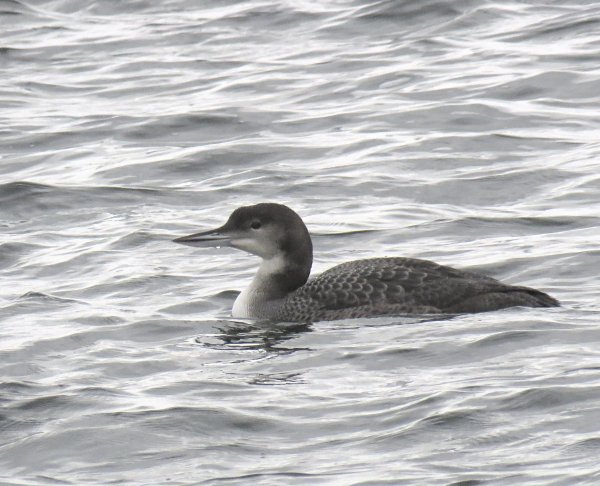
My first outing was a trip to Farmoor a few weekends back to pay homage to the long staying juvenile Great Northern Diver that is spending the winter there. This bird has been around for a while now and clearly is finding it to its liking. There have been countless photos of it dismembering the invasive Signal Crayfish that are so prolific in our waters these days. On the day that I went it was right in the far north west corner of F1 and despite trying to see it from across the other side, it was only when I actually walked all the way around that I was able to find it. The light was very overcast by then so my record shots have come out rather monotonic but still it was very nice to see such a smart and impressive bird comparatively close up and looking so relaxed and at home.

The over-wintering juvenile Great Norther Diver


County First!

The next outing took place a couple of weeks ago. News broke late one afternoon of a Pallas' Warbler that had been found at Abingdon sewage works by GB. The back of camera shots were suitably gripping and whilst the news broke too late for me to contemplate a twitch I understand that a couple of people did actually manage it in the 30 minute window before dusk. 

Pallas' Warbler are usually found on the east coast in autumn and inland birds are very rare. I remember twitching my first one in Berkshire back in 2013 when one over-wintered along a river on the Berkshire/Hampshire border. Since then, I have seen three more: Cornwall (self-found!), Spurn (briefly) and Norfolk (fantastic views at Thornham) so in terms of my national listing this was not particularly important. However, in terms of Oxon listing there was no doubting the significance of this find as it was a county first. This meant that all the serious county twitchers were going to be there the next day and naturally enough I was going to try to see it too. 

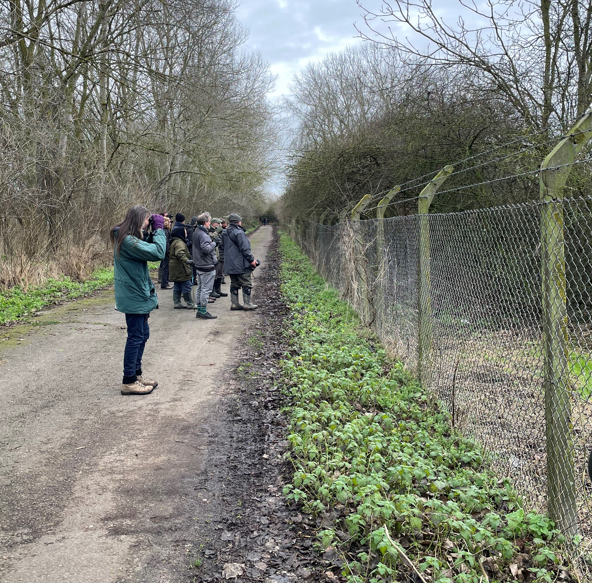
Overnight it was ridiculously cold, going down to a freezing -5 degrees. This made me wonder whether being there at first light was actually the best tactic or whether to wait a little bit until things warmed up a little might not be better. So in the end I rocked up at the sewage works at a little after 9 a.m. to find the great and the good of the county birding world all assembled already: they'd all been there since first light of course, being proper hardcore twitchers. Still it hadn't done them any good as there'd been no sign of it so far. In fact it had just got to the stage where intense concentration in looking for the target was starting to wane and was giving way to aimiable chatting instead. It was quite something to see everyone all there together. Since the pandemic there hadn't been a chance for any social gatherings in the Oxon birding world so for many this was a good chance for a long overdue catch up.

Having come a bit later I was still quite keen and diligently searched along the northern boundary of the treatment works for the target bird. There were plenty of Chiffchaffs about and one or two Goldcrest which would get the pulse racing until the head was seen properly but not our much sought after county first. After about 30 minutes of this a shout went up to the west. We all knew what this meant and as one we hurried to investigate. It turned out that PR had seen it briefly in a more wooded area off to the north west of the works. We all spread out looking and a minute or two later PR had it again in a tree next to the path. We all converged on the spot and sure enough there it was, zipping about high up in an Alder tree. It was hard to pin down as it was very active but I managed to see it well enough to be sure of what I was looking at. We then all followed it for several minutes as it worked its way through the tree tops before it went deeper into the wood and was lost to view.

After that, the atmosphere relaxed noticeably. There was a lot of chatting and mutual back slapping and comparing back of camera photos from those that had managed to get off a shot. The crowd also began to disperse, with some of those who'd been there since first light starting to head off home. A few late comers arrived to find that always difficult twitching situation where everyone there has seen it well and is no longer looking and you're left trying to refind it on your own. For myself, having arrived a bit later and having seen the bird comparatively quickly I was in no particular hurry to leave. I wandered back to the main sewage work area for a bit to take a look at the Siberian Chiffchaffs which tended to hang out at this area. They see to be faithful to a small area next to the concrete treatment rings and I saw them well enough. I then helped some of the late arrivals to look for the bird again but without any success. Eventually hunger started to get the better of me and I headed back for home with a shiny new county tick to my name.

Some of the lingering twitchers watching the Siberian Chiffies


A couple of stunning photos of the Pallas' Warbler taken a few days later, courtesy of Roger Wyatt


A couple of Siberian Chiffchaff photos courtesy of Roger Wyatt
 

Pallas' Revisited and a Duck

As everyone suspected, the Pallas' stuck around. Having located the insect oasis that is the sewage works, there was really no where else for it to go. It was onto a good thing for an over-wintering insect eating bird and anywhere else would probably not sustain it. It was reported every day since as various people, local and national came to pay homage. A week or so later I went back for seconds one Saturday afternoon. There in the company of less than ten people I had regular glimpses of it as it worked its way along the trees and hedges of the narrow wooded strip north of the sewage works. The views were never crippling but I managed some nice pale lemon rump views which are always very pleasing.

I didn't stay too long as the views were unlikely to get better and there was no point in attempting a photo given the distances, the gloomy light and how comparatively elusive the bird was. Instead I chose to nip over to Thrupp lake nearby at Radley to see the drake Ring-necked Duck. It was immediately on view though somewhat distant. I busied myself with trying to photograph it but given the circumstances it was always just going to be a record shot. Also present on the lake were seven Red-crested Pochard, a species that I don't happen to see that often. There is a bit of a glut of RND's nationally at the moment and it's nice to see that Oxfordshire is getting in on this action. Indeed just in Oxon, apart from this bird there is a lingering female at Appleford GPs which is being seen from time to time.

A photo of the distant Ring-necked Duck


All in all, it has been a great start to the county birding year. A county first like that is almost certainly a shoe in for the county bird of the year unless something even rarer turns up. Still you never know!


Thursday, 20 January 2022

January Durham Run

After having spent Christmas with us, our eldest daughter asked me if I could give her a lift back up to Durham at the start of January. With not much happening I felt that a change of scenery would help to shake off the January blues so I agreed. As usual I spent the week prior to our trip looking to see what might be around in the North East but, as is often the case at this time of year, there was nothing particular tempting to be seen. So in the end I decided to keep it fairly low key and stress free, choosing just to enjoy some of the local specialities.

Rather than our usual 8am start on Saturday we had a more leisurely departure at 10am, arriving at my daughter's house that she shares with her boyfriend, after an uneventful run at around 2pm. After a coffee and our packed lunch I proposed a local walk along the River Wear so I wouldn't have to do any more driving that afternoon. It was cold but sunny and I had a specific target in mind of wanting to see a Dipper which I'd not seen for a quite a while now. Having described the sort of shallow runs that they like, my daughter, who regularly walked along the river, took me to some ideal habitat where sure enough there was the sought after distant bobbing bird. With the addition of a couple of Goosander, a Grey Wagtail and some Little Grebes it was a very pleasant afternoon's walk.


Distant Dipper

Back at home I pootled about for a bit before we ordered some takeaway from my favourite Durham Thai restaurant - my treat for having done the drive. Then, after watching some Netflix Korean dramas in the evening (I have become obsessed!) it was time to turn in for the night.

The next day I was up reasonable early and out the door before my daughter was even up. I'd picked out a couple of local birds to try and see with the first being at the unlikely sounding location of a Morrison's carpark at Doxford Park in Sunderland where a third winter Iceland Gull was supposed to be hanging out. I arrived to a deserted car park (it was late opening on Sunday) and at first glance it seemed completely empty with not a gull to be seen. Indeed I had already started programming my next destination into my sat nav when I thought I'd better just chuck a few pieces of bread out to make sure. Low and behold within a few seconds I was surrounded by a couple of dozen Black-headed Gulls. This was more like it! A short while later the first larger gulls started to arrive and finally the Iceland Gull itself showed up. It had a liking for sitting on a roof top right in the corner and as I didn't have a great deal of bread to hand I had to use it sparingly at the right moment to entice it down to the ground but eventually it obliged.


The carpark Iceland Gull

Having got some reasonable photos I then decided to head on to my second destination, namely South Shields. It was not somewhere that I'd been to before but various reports of Snow Buntings just south of the pier had tempted me to go and take a look. I arrived and eventually managed to put together enough coins to pay for the parking - no contactless payment for some reason! I then wandered down to the dune area just south of the pier. On a sunny Sunday morning the area was full of people walking their dogs and at first glance it seemed fairly hopeless. 

Looking north towards South Shields pier
 

Looking around the only areas which were quieter were in the dune areas between the beach and the fairground so I had a little explore but there was nothing to see. Back towards the pier I encountered a fellow birder who turned out to be a chatty local. He told me that the flock of 20 or so Snow Buntings were normally right next to the pier where we were standing but that they'd not been seen today in two hours of searching. He said that by the steps people put seed out so I went over to take a look and there was a woman quietly watching a single Snow Bunting sitting on a rock. Relieved to have at least one to look at I relayed this information back to my new companion and set about taking a few snaps.

Like most Snow Buntings, it was very approachable and just sat there

Having finally seen my target I decided to have a wander along the pier to see what was about. 

Looking east at the start of the pier with the River Tyne on the left

 On the calm sea south of the pier there were a couple of Red-throated Divers fishing close in.


Along the pier itself there was a mixed flock of waders roosting on the rocks at the base of the pier, a mix of Dunlin, Redshank, Sanderling and a Ringed Plover.


On the sea at the end of the pier there were a few Guillemots fishing and on the River Tyne iteself there was a single Eider duck. With Turnstones and Rock Pipits also about it was nice to add some coastal species to my year list.

A Tyne Eider


A winter Guillemot

The small lighthouse at the end of the pier

It was very pleasant in the sunshine to wander about and enjoy the different surroundings and some different birds. Eventually though I realised it was time to start heading back so I retraced my steps and fired up the Gnome mobile. The journey southwards was long but uneventful. I punctuated it with a couple of quick stops for some tea from my flask and with Radio 4 for company I got back safely at tea time. It had been an enjoyable albeit low key trip up to the North East.

Monday, 17 January 2022

The Late (Again!) End of Year Review

Whereas other bloggers are now already blogging about their new year expeditions I'm still collecting my thoughts about the previous year. I seem to have got into a habit of being late with my end of year reviews and this year is no exception. Still, better late than never, here is my review of what was a pretty decent year's birding. As usual I will divide it up into the usual patch, county, national and non-bird sections but all managed to perform well this year.

Patch Birding

Regular readers will know that much of my day to day birding efforts are taking up with my local Port Meadow patch. I have already done a comprehensive review of the year (see here) so this is just an executive summary. It was a record breaking year in terms of year listing with 136 strict BOU species + 2 release scheme birds (Crane and White Stork) and two feral species (Snow Goose and Red-breasted Goose). One of these days I'm going to sit down and write my blog piece about Gnome listing but for now I'll leave the total deconstructed as above. The highlights of the year were: a Black Redstart in March (a personal patch tick), a Pectoral Sandpiper in December and a Dotterel also in December (also a Patch tick). The Port Meadow Bird of the Year was the Dotterel.

The Dotterel, courtesy of the finder Ollie Padget


County Birding

It was a very good year for county birding as well. Some years, outside of my patch it can be very quiet with no additions to my county year list but this year I managed three ticks. My day job meant that my twitching was more constrained so I had the extra challenge of trying to do door to door twitches within the one hour that I have off during daylight hours. This added a certain frisson to the twitching!

First up was the Purple Sandpiper at Farmoor. I had been away down in Cornwall for the only other twitchable county bird since I started birding at the end of 2007 so when this was found one August evening at Farmoor I hurried down there to make amends. 

Farmoor Purple Sandpiper

In September, I had the chance of another county grip back when a pair of Roseate Terns were found early afternoon at Farmoor. Again, I'd been away for the last twitchable bird and I managed to twitch them and return to my desk all within one hour. Hectic stuff but great to get such close views of this lovely Tern species.

The two Roseate Terns

It wasn't until December that my third county tick turned up when a Little Auk was found down on the river at Farmoor. Once again it was a mad dash to see it and get back all within one hour but somehow I did it, adding what was the ultimate county Mega to my list.

The Little Auk

The only other county trip of note was a morning spent up at Wantage to see an elusive Wryneck. The main enjoyment was winkling out views of this shy species but in the end it showed well enough.

The Wantage Wryneck

There is little contest for the county Bird of the Year: it has to be the Little Auk just for sheer rarity value. Only two county listers had ever seen one before (apart from some rescue birds) so it was a tick for just about everyone.


National Birding

My day job has rather been affecting my national birding as well. As I am confined to weekends, I either have to take the day off or do a weekend twitch. This has resulted in at least two missed life ticks this year but I still managed six additions to my coveted personal life list.

April was a productive month with three lifers no less! To start with there was a trip down to Cornwall that got me the Northern Mockingbird and the Newlyn American Herring Gull. Both birds fortunately hung around throughout the lockdown and were obliging enough for me to turn up and tick them fairly easily.

The Northern Mockingbird

The Newlyn American Herring Gull

The following weekend it was off to Sussex for the White-throated Sparrow at Barcombe. This involved waiting reasonable lengths of time before getting comparatively brief views but it was a lovely bird that certainly warranted putting in the time and effort for.

Barcombe White-throated Sparrow

Nationally, it was rather quiet then until June when we had a trip en famille down to Cornwall. Cornwall itself was rather uninteresting with just an adult Rose-coloured Starling worthy of note but on the way back we stopped off for the Ham Wall River Warbler which, after a tense wait, I managed to see just before the family needed to be picked up from Glastonbury.

The River Warbler

It wasn't until September that I had my next tick with the long-staying White-tailed Lapwing up at Blacktoft Sands. This was a lovely little reserve with a great supporting cast and the star turn was obliging enough.

The White-tailed Lapwing

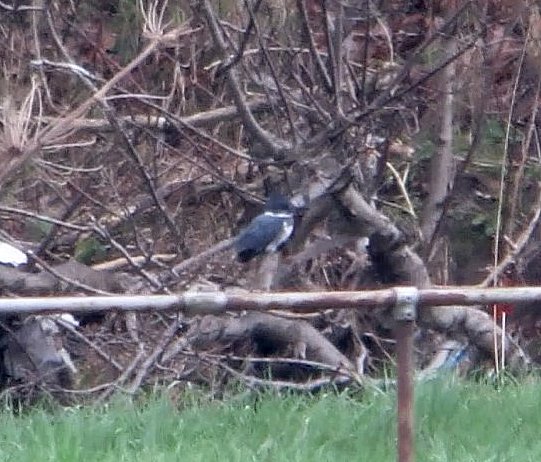
I thought that that was going to be it but then in the last few days of the year I managed to snaffle the elusive Belted Kingfisher up in Lancashire. The views were distant but prolonged and, given all the tales of multiple dips on the internet, I was very happy to have this Mega in the bag.

The Belted Kingfisher

Other trips of note included a Durham run in January on which I saw the Northern Eider at Redcar. This is a subspecies tick for me and will therefore appear somewhere on the convoluted Gnome listing hierarchy.

The Redcar Northern Eider

The national Bird of the Year award is a really tricky one as they were all much appreciated in their own way. The Mockingbird and the Kingfisher are both real Megas in their own right; the American Herring Gull was something that I had long wanted to catch up with and I really enjoyed the Sparrow, Lapwing and River Warbler twitches. So this year I am going to be controversial and share the award equally amongst all of them.

Non-birding

There were only a couple of non-birding trips this year in the form of jaunts down to the New Forest for a couple of Orchid ticks that I still needed, namely Fragrant Heath Orchid and the tiny Bog Orchid. I enjoyed having something to do in the height of summer and with a side helping of some Honey Buzzard views it was a great couple of trips.

Bog Orchid

Summary

So there you have it: despite the restrictions of a day job and the on-going pandemic I managed to see some decent birds and to keep my various county and national lists jogging along. I really appreciate having mutliple different outlets for my birding in the form of patch, county and national birding - each offers me great enjoyment in their own way. Let's hope that 2022 is just as good.


Friday, 31 December 2021

End of Year Finale - Belted Kingfisher!

Any birder with their ear even remotely near to the twitching ground will be very aware of the ongoing presence of a Belted Kingfisher up in Lancashire for the last couple of months. With only four previous records in this country, this large American Kingfisher was a proper Mega rarity that was always going to attract a large amount of interest. It was initially found by an angler on 8th November on the River Ribble east of Preston though as there was no subsequent sign of it, the veracity of the report was initially questioned. However, on the 14th it was seen again though after that sighting it seemed to vanish. On the 25th November it was seen once more at the bottom of a treachorous and steep slope below Red Scar crematorium and so began a frenzy of twitching attempts by twitchers keen to add it to their list. By all accounts it was an uncertain venture: not only was the bird highly unpredictable as to when it might be seen but navigating the slope down to the river bank was a very hazardous matter with emergency services having to be called on at least one occasion to rescue people who had injured themselves falling down what became known as the Slope of Death. I personally knew of at least two birders who had dipped multiple times trying to see the bird at this location. For me to consider any kind of longer distance twich the odds need to be firmly in my favour and the low success rate, not to mention the risk to life and limb meant that I was not even comtemplating an attempt. 

It was last seen on 30th November before a series of days of "no sign" showed that it had moved on. However, on the 9th December it was "reported" at Roach Bridge on the River Darwen and then on the 17th it spent a day on the Leeds and Liverpool Canal. In both cases these seemed to be one day reports only. Then on the 20th it was seen again at Roach Bridge and on each day following that. Arrangements started to be made about parking and the farmer whose field it was started charging a £10 entrance fee. With it finally being nailed down I started to keep a closer eye on proceedings though there was the small matter of Christmas to negotiate so it wasn't until our guests had left that I started to consider this as an actual potential sortie. It seemed that being there at first light (which fortunately isn't that early at this time of year) was the best tactic but as it was at least 3 hours from Oxford I decided that an overnighter at a nearby Air BnB would be the best tactic. And so it was that on the 29th I set off just before 4pm up the M6 for Preston, stopping in briefly at Port Meadow en route to see the Red-breasted Geese that had relocated from Otmoor to my patch. The journey northwards was uneventful though somewhat marred by news that the Belted Kingfisher had relocated back to the Leeds and Liverpool Canal that afternoon before flying off north at dusk. I mulled this over as I drove: could it have moved? It could well be that it roosted at Roach Bridge as it had been seen every day since the 20th at least in the morning but in the afternoon liked to wander further afield. I concluded that I would stick with my plan of heading to Roach Bridge at first light and then see how things unfolded. I arrived at my Air BnB after an uneventful journey and settled in for the night with a picnic supper in my room. At only £29 for the night and only 10 minutes from Roach Bridge it was pretty much an ideal location for me and I settled in for the night.
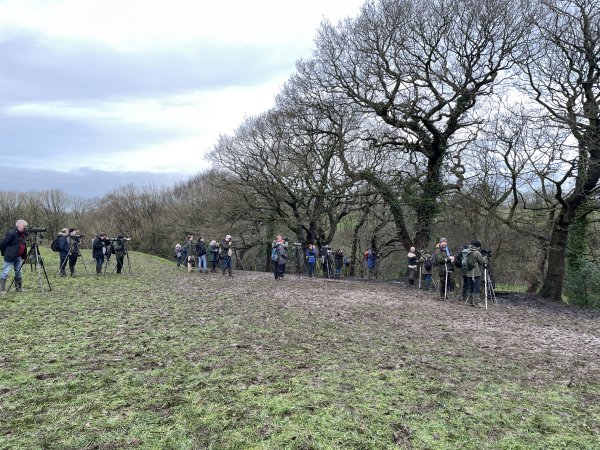
The next morning I was up and out the door before my host was even up. I arrived at Roach Bridge at around 7:30 a.m. at the same time as several other birders' cars. Fortunately there was some safe parking right on site which saved me the walk along the road in the dark (not to mention the £10 parking fee) of the official parking site. It was weird tooling up and trudging off in the dark with other  birders - a strange congregation of anonymous shadows all with one aim in mind. The footpath was indeed the slurry of mud that everyone had mentioned and I was worried about losing my footing though it was actually relatively easy to negotiate. At the top of the path we were met by the farmer collecting his £10 fee for access to the field. We then had to slog our way across the boggy field in the dark - I got so hot doing this with all my gear on that I wondered if I was going to pass out! Finally I made it to the viewing spot and picked a spot where I could look down over the steep escarpment along the length of the river.

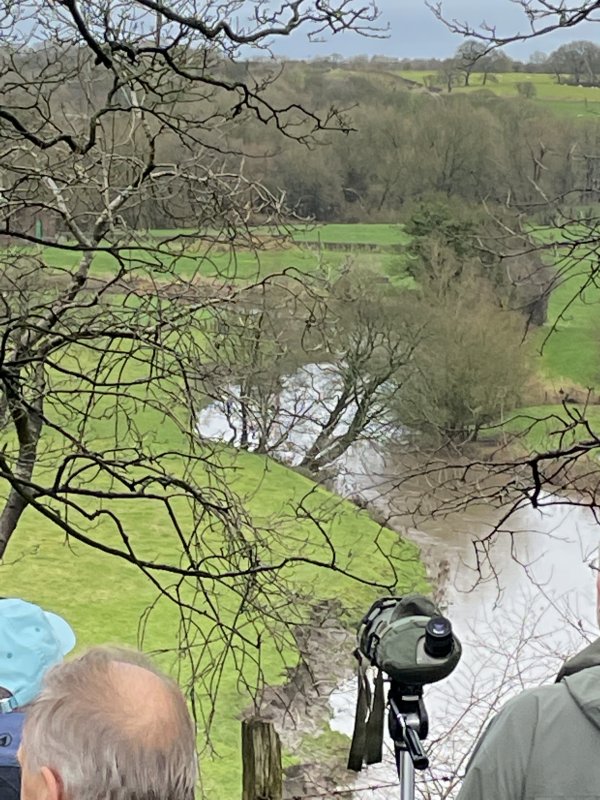
Slowly dawn broke and we started to peer along the length of the river for any signs of our target bird. There were a couple of false alarms where first a Jay and then a Crow got people over excited before reality prevailed. Then just before 9 a.m. we all heard the distinct rattling call of the Belted Kingfisher - at least it was still about! A few minutes later it called again and then some people saw it in flight. I'd discovered in the light that my chosen viewing spot wasn't the best vantage point as there were several trees obscuring the view so whilst some people around me had brieft flight views of a couple of seconds before a Crow chased it off, I myself didn't see it at all. It has been seen in a clump of Alders on the left-hand bank of the river so further away than the nearby Willow on the right-hand bank that was its favoured perch. After having been chased off it had flown off upstream out of sight.

Looking down at the clump of Alders on the left-hand side of the river
 

Time passed and I started to wonder if I was going to have to put this down as "heard only". I only have one other bird on my national list as "heard only", that being the last tickable Lady Amhurst's Pheasant which I'd never actually seen but had heard making its distintive call. There was nothing I could do now but sit it out and hope that the bird would return. After the initial sighting and the news going out, the birders who'd opted to start at the canal instead started to turn up so our numbers swelled. We all stood around, eyes trained on the two trees along the river but there was nothing to see. I started to wonder if the whole trip had been worth it if this was all I was going to get. Twitching can be a cruel game!

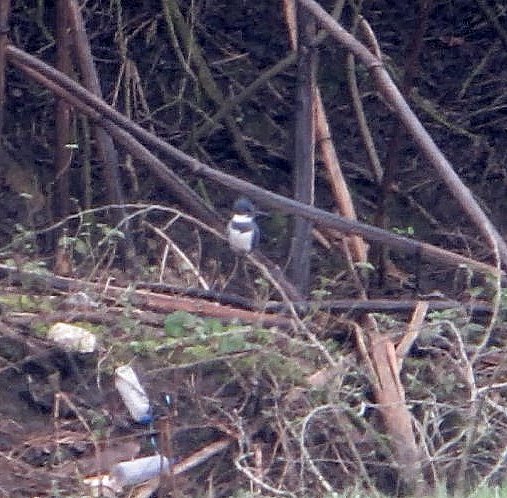
Suddenly at around 10:30 a.m.I was awoken from my circling thoughts of heard-only dippage when someone yelled out that he had it, right in the far distance. The usual pandemonium of trying to get everyone on it ensued but fortunately he came round and started to put people's scopes on the bird including mine. I peered through my duly aimed optics and at first I could only see the distant far river bank but as my eyes tuned it I spotted a small blue-grey blob sitting low on a branch. There it was - the Belted Kingfisher!

This is a much enlarged video grab so my initial sighting wasn't nearly as good as this!

To start with I helped to get other people on the bird, even offering views through my scope but as the bird was very cooperative and just sat there eventually everyone managed to train their scopes on it and I could get on with taking some video footage. It was some 500m away (I measured it on Google maps) so any photography was always going to be record shot only but given stories of how hard this bird had been to connect with I was happy just to be seeing it. After about 10 minutes of watching it, it flew off.


Some video footage of the Belted Kingfisher

It was a much more relaxed atmosphere in the twitching ranks now that the bird had shown though more stragglers were still arriving who had yet to see it. I got chatting with a couple of birders next to me who knew me from Cornwall - it's a small world! At some time after 11a.m. it reappeared along this same far section where it stayed for more than half an hour, occasionally moving a few yards along the river. Whilst the views were very distant they were at least prolonged and we all watched this Mega with contentment.

Another video grab


Twitchers in the mud!

Finally about about 11:45 a.m. it flew off again and I felt that I'd had enough. I slogged my way through the boggy field back to the car though, wrapped in my warm glow of success, I didn't mind the exertion. Back at the car I had a quick picnic lunch before heading the short distance to the M6 and southwards towards home. The journey back was uneventful and I arrived back in time for my customary celebratory tea in the bosom of my family. It had been a great end of year finale!


Addendum

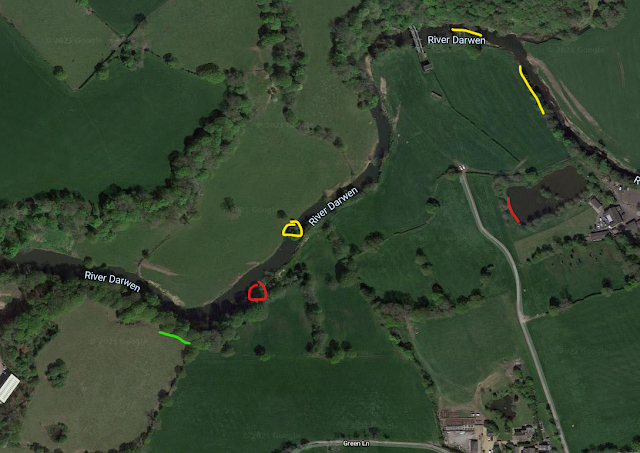
To help people who might still be contemplating a trip to see this bird, below is a map showing the key locations. The green line is the end of the muddy field where you view from. The red circle is the fallen Willow on the right-hand side, where the best photos come from. The yellow circle is the clump of Alders where it was first seen this morning. The two yellow lines are the distant views that I had today - this is about 500m from the viewing point. The red line is the fishing lake where it can also be seen. Going first thing seems to be the best tactic and wellingtons are essential.


Thursday, 2 December 2021

Farmoor Little Auk

I posted a while ago about what birds I might drop everything for. Each afternoon I have a one hour window off so if I can fit a twitch into that time slot then I'll do so. Certainly for the Roseate Terns at Farmoor this year I made a mad dash to see them and just managed it within that time window. However, when a Little Auk was "reported on the Thames" early afternoon and then firmed up just after 2pm by JD it was a "drop everything" situation. There have been no twitchable Little Auks in the county this century: with just a couple of records of wrecked birds that have been picked up in the county only the most senior of county birders might possibly have had this species on their list. However, could I do this within one hour? Google was saying 16 minutes from my door to the parking spot in Farmoor village. Then it was an 800m dash to the lock. Time to check out my fitness levels! 

Within 10 minutes of the bird being confirmed I had messaged my boss to say that I was taking my walk now and was out the door and headed to Farmoor. I parked up just as TM arrived and we both got tooled up quickly. I opted to leave my scope in the car and not to wear a coat so as not to overheat, then it was a combination of running and walking (sadly I'm not as fit as I hoped and couldn't run the whole way) along the track until we could see the river and the dozen or so birders standing near the lock. This spurred us on to make the final dash along the river bank where to our relief the bird was immediately on show on the far side in front of a boat. 


Usually I would spend some time enjoying the bird, photographing or videoing it and then chatting with the other birders but in this instance I didn't have time so I took a few record shots and a bit of video and said a few brief words with the some of the others. This was only my second ever sighting of a Little Auk with my first being a few seconds viewing of one on the sea in someone else's scope at Whitburn in Co. Durham a few years ago. Accordingly, I should have been revelling in the close up views. However, whilst the bird was reasonably lively it seemed to swimming around aimlessly in lots of directions without diving at all or trying to feed, and seemed a bit panicky and lost (as indeed it was). My heart went out to the poor thing - it's the sad reality that an inland Little Auk is usually very much on borrowed time and this waif looked all too out of place. However, I didn't really have time to savour all this at the time and within 10 minutes of arriving I was off again, heading back at a brisk walking pace to the car. As I went I passed various county birders coming in the opposite direction, all in a hurry to connect with this mega blocker. I was soon back at the car and after carefully negotiating the maze of birders' cars, parked everywhere along the road, I made it back into Oxford and back home exactly one hour after I left. Success!

Some shaky video footage I took whilst I was briefly there 

To my amazement, the bird was reported as still present the next morning, allowing some straggler birders to get to see it. Feeling more and more sorry for the bird, I broached the subject of a rescue attempt and this was where the power of WhatsApp kicked in with useful contributions from various people. The lock keeper's contact details were obtained and Ollie Padget, a sea-bird research expert and registered ringer set off to see what could be done. We all followed proceedings on WhatsApp with bated breath before the bird was finally captured.

Ollie with the bird in hand

Some video footage taken by Peter Alfrey (c)

Ollie, a Port Meadow regular, happens to live close to me and I got to take another peak at the bird when he brought it back. After some consultation with some of his learned colleagues in the sea bird reasearch department it was decided that the best thing was for it to be taken back to the sea as quickly as possible and released at dusk (to avoid being immediately predated by gulls). It was examined carefully in the hand where it was discovered to have a reasonable amount of body fat on it which meant that it would hopefully have enough strength to get through the time it would take to be released.

Awaiting transportation back to the coast

That afternoon it was taken by Conor Mackenzie down to Somerset where it was released in a tidal tributory of the Severn. Hopefully it will now actually stand a chance of making it back to the sea - it's certainly got a better chance than being on the Thames at Farmoor! So top teamwork by Team Oxon Birders resulted in a much more hopeful outcome for this lovely little bird and I could enjoy the warm glow of the fall of a massive blocker with a clear conscience.