Yet another compilation of my daily postings from Pendeen Birding from a recent visit down to Cornwall there. As before, there's a lot of detail about moths and plants and not very much actually happens. Read on if you wish - you have been warned!
19th July Aish Tor & Pendeen
This week our cottage was supposed to be booked up by paying guests. However, whilst all the other high summer weeks had gone, for some reason this week had stayed empty. There was some last minute interest but when that fell through the idea was mooted that perhaps we could go down for an impromptu bonus family holiday. Also, the internet had apparently stopped working down there and we were finding it almost impossible to sort it out remotely so it would be much easier if we were actually down there. In the end collectively we didn't take much persuading and we decided to go for it. Having learnt our lesson from previous trips we decided to avoid travelling on the dreaded first Saturday of the summer holidays and so we set off reasonably early for us at 9:30 a.m. on Sunday morning and with the roads nice and clear we made good progress.
Now, if I were coming down on my own I'd be stopping of en route to see some wildlife of interest and having done my research I'd homed in on Aish Tor on the edge of Dartmoor in Devon which was a good site for the rare High Brown Fritillary. However, being en famille it might not be so straight-forward to do this. I tentatively put it to my family who were surprisingly OK with this idea - the plan being that they could all go for a walk whilst I hunted for my butterfly. So, given the lack of traffic, in the surprisingly short time of a little over two and a half hours we turned off the A38 by Ashburton and made our way along the narrow Devon lanes to the car park half way up Aish Tor. This turned to be a rather steep, bracken-covered hill overlooking the Dart valley. I'd been eyeing up the weather pessimistically en route as it had been looking very cloudy for much of the journey and even with the occasional rain shower. Fortunately though we seemed to have arrived in the middle of a rare sunny interval though it was rather windy and conditions were far from ideal I hurriedly got my gear together and set off up the hill leaving the rest of the family to sort themselves out though the sun soon went it leaving it all too cloudy.
 |
| Aish Tor |
There were plenty of Gatekeepers and Meadow Browns about which my
daughters kept pointing out to me in their effort to help. However, I
couldn't see any Fritillaries on the wing at all. The rest of the
family headed off to do their own thing and I started to search the area
more thoroughly. I found an old quarry which was sheltered from the
wind and which looked promising though still no luck. As I headed higher
up the hill I saw a larger butterfly flitting about so I hurried up
there. Near the top the bracken gave way to gorse and heather with clear patches in
between and these larger butterflies turned out to be Grayling, normally
a good butterfly to see though it wasn't what I was after today. I carried on my search, snapping the odd flower that I didn't immediately recognise or the occasional moth that I came across.
 |
| The cryptic Grayling |
 |
| Slender St. John's Wort |
 |
| Wood Sage |
Despondent at my lack of success I headed back down the hill again where I met up with our younger daughter who thought that she'd seen something promising a bit off piste in the bracken. With no other leads to work with I thought that I might as well chase it up and so we headed off to try and find it again. We didn't have any luck and eventually found ourselves back down by the old quarry. There I spotted something large and orangish zooming about. It looked promising but I soon lost it to view. Time had been marching on so disappointed we headed back to the car to get our picnic lunch. There we found the rest of the family tucking into their food as well. I took my sandwich and negotiated a final look whilst I ate my lunch so I hurried back off to the quarry area. There I soon found my orange butterfly again though it turned out to be a Small Tortoiseshell. I did a quick circuit all around the quarry again and was just working my way back to where I'd started when Bingo! there was a Fritillary right in front of me nectaring on some bramble. Having done some research I knew what to look for to try to distinguish it from the near identical Dark Green Fritillary but agonisingly it flew off before I could pin it down. Fortunately it had just skipped to the next bramble patch just a few yards away but tucked deep into the bracken. I carefully waded in and got a better view of it: the body was a uniform dark brown with not a hint of green, the third spots on the upper wing did appear indented and the underwing had the diagnostic darker orange patches between the outer and inner circles of white spots. That made it a High Brown - Result! Sadly it flew to another bramble patch deeper within the bracken and completely out of sight before I could get a photo but at least I'd seen one. I hung around for a while hoping that it would re-appear and did a quick circuit of the quarry again where I managed to turn out a Green Hairstreak. Try as I might I couldn't re-find it and eventually I got a phone call from the rest of the family who were growing restless so I headed back to the car.
 |
| Green Hairstreak |
 |
| Rush Veneer - an immigrant moth |
It was time to head off so it was back to the A38 where we made good progress, arriving at Penzance in about an hour and three quarters. A reviving cup of tea in the Sainsburys café and then the food shop for the week and it was off to the cottage. We played our usual "guess how many Buzzards we will see" game between Penzance and Pendeen but sadly the result was Nil Point.
We found the cottage bathed in glorious late afternoon sunshine with not a breath of wind. It seemed almost unnaturally to see it in such lovely weather, so used were we to visiting in cold, wind and rain. We spent the rest of the day just pootling around the cottage taking in all the sites. Daughter 2 found a Slow Worm and there was a Painted Lady and two Red Admirals to admire in the garden. We wandered down to the lighthouse and stared at the sea for a while before heading back for dinner. It's good to be back!
 |
| Red Admiral |
 |
| Slow Worm |
 |
| Pendeen sunset |
20th July Pendeen & Marazion
In stark contrast to yesterday's perfect weather, we awoke this morning at a suitably late time to a heavy Pendeen mist and drizzly rain. This didn't seem to have affected the moth trap which I'd put out last night which was absolutely heaving with moths. The only problem was going to be sorting through them all in the rainy conditions. In the end I did what I usually do back home in Oxford and I brought it inside so that I could sort things out in the dry. However, there were so many flies and moths in the trap that our entrance area by the door was soon buzzing with flies and moths, much to everyone else's annoyance. In the end I could do nothing more than quickly scan through all the trays and then transfer them into a waterproof container which I stashed down at the end of the garden out of the wind and rain, where they would be safe and I could come back later and check them out. I then went back to the cottage and spent a busy fifteen minutes removing all the insects from the entrance area where they shouldn't be. In hindsight I should have just left the trap where it was until the weather improved. Still I'd seen enough to realised that this was probably my best every catch in terms of numbers (I normally don't catch great numbers back in Oxford due to my urban location, my small home-made trap and my actinic bulb that I use so as not to annoy the neighbours). What's more there were lots of moths that I wasn't familiar with from back home which is one of the delights of mothing in a different location. The children were very taken with the four large Elephant Hawkmoths in the trap and they each wanted one on their hand. As I write this I'm still working on quite a few of the ID's but it was certainly a good catch.
 |
| Elephant Hawk Moth |
 |
| Plain Golden Y |
 |
| A rather worn Kent Black Arches - I'm not sure how rare this is down here in Cornwall but I know that I'd be very pleased to catch one of these back in Oxon |
The weather briefly lifted mid morning but then closed in again so we decided to do what we usually do in such circumstances, namely head over to the other coast to Marazion after lunch. The fog was lingering on the hills still as we drove across but once we descended into Penzance itself it started to brighten up. We tried to park at the charity car park near the entrance to the standing stone area of the RSPB marsh only to find that it had been taken over by the St. Aubyns Estate and that it was closed. A shame, as I always liked that car park. So we headed back to the Station Inn car park and walked along the beach to Marazion from there. There was a nice flock of forty or so waders dodging the kite surfers: mostly Sanderling with a few Dunlin and Turnstone thrown in.
 |
| Marazion waders |
It was breezy but nice and sunny and we were all in a good holiday mood as we ambled along. We headed over across the causeway to the Mount and had a cup of tea in the café there. Then the girls headed into Marazion itself to do some gallery viewing whilst L (our nine year old son) and I wandered back along the beach. He amused himself building sand castles by the Red River mouth whilst I rummaged through the coastal plants there. A few Swifts were feeding overhead and I checked them carefully for rarer cousins but of course without luck.
 |
| Sea Holly - one of my favourite coastal plants |
 |
| Sea Sandwort |
 |
| Sea Kale |
 |
| Frosted Orache |
Eventually the rest of the family caught up with us and we wandered back along the beach to the car. A quick nip into the supermarket for provisions before we headed back to the cottage for dinner. Whilst my VLW cooked I went to sort through the moths properly, making sure that I had photographed all the ones that I didn't recognise for ID'ing when I had more time.
 |
| Peach Blossom - always one of my favourite moths |
It was still rather windy and cold by the cottage so instead of our usual post-dinner walk to the lighthouse we stayed in and played Trivial Pursuit before turning in for the evening.
21st July Just Pendeen
Today was warm and sunny though with quite a stiff south-westerly breeze to take the edge off the temperatures. With nothing urgent to chase down I treated myself to another lie-in this morning and my VLW and I put the world to rights over a cup of tea as we sat in bed and stared out the window across the moors towards the tin mine ruins below Pendeen. After that and with no moth trap to unpack (it had been too breezy the night before) I pootled around the cottage for a while before I started to get restless. I happened to glance out the window and saw that the sea was looking a bit rougher than it had been earlier and that the waves appeared to be coming in towards the shore a little. Normally when there's a south westerly wind there isn't much wave definition on the water where we are but this looked a bit more westerly. With nothing better to do I decided to head down to the Watch for a spot of sea watching.
On the way down I spotted a large orange butterfly enjoying the lovely summer flowers that are growing along the lighthouse boundary wall as you walk down towards the gate. Dwarfing the neighbouring Meadow Browns in size it was clearly a Fritillary and could only be a Dark Green. I managed a single record shot before it was carried away by the breeze. I've seen Dark Green Frits only once before here at Pendeen when I saw one bombing over the bracken whilst walking towards Portheras beach.
 |
| Dark Green Fritillary - a rubbish angle but at least you can see what it is |
Down at the Watch of course I had the place to myself as with a south westerly wind all sensible sea watchers would be over at PG. Still, I'd negotiated a three quarter hour session with my VLW and I could relax and enjoy myself. The light was perfect with full-on sunshine shining directly behind me so everything was perfectly lit. In fact it was so good that I soon adopted the tactics of scanning with my bins and then going over to the scope should I need to. There were plenty of the usual Manxies going by reasonably close in. My hunch about the wind seemed correct that it was just north of westerly and the birds were coming in close as they passed the point. I picked up a larger brown bird leisurely shearing away out in front of me and got my scope on it expecting it to be an immature Gannet of some description. Much to my delight it turned out to be a Cory's effortlessly shearing away with hardly a flap of its wings. In the bright light I could make out all the details including it's yellowish bill and watched as it seemed to be coming in closer as it rounded the point. I enjoyed it for several minutes as it worked its way past and by the end it must have been well within the reef distance. This was by far my best ever view of this species with previous sightings having been very distant views at PG - if only all sea watching could be like this! Pleased with this I blagged an extra half hour with my VLW in the hope of seeing some more good stuff but I noticed that the wind was moving back to its usual south west direction and I saw nothing more of interest. I realised afterwards that I'd seen no auks at all and hardly any Gannets with only a few Kittiwakes and Fulmars to break up the Manx Shearwater monotony.
 |
| I found this female Silver-studded Blue down by the lighthouse - whilst they are to be found locally I've not seen them just here before |
Back home the others were up and about now so we decided to spend the day locally. We headed over to Boat Cove first, stopping to admire the seals close in by the rocks there. Unfortunately we weren't the only people to have this idea - I've never seen the cove so packed with people and I could see quite a few over at Portheras Beach as well. The reason was clear: it was lovely and sheltered in the cove from the wind. We loafed about for a while before heading back up the path to the cottage for lunch.
 |
| Boat Cove Seal |
That afternoon we opted to walk west along the coast path to Geevor Tin mine before heading up the hill back into Pendeen. By the stream at the bottom of the valley just south of the cottage one can often find Small Peal-bordered Fritillaries at this time of year and sure enough I spotted one working its way along the stream. The children, who had gone on ahead, claimed that they'd seen a dragonfly as well and there was indeed a lovely Golden Ringed Dragonfly working the area - the first that I've seen on the stream though they're plentiful enough at Kenidjack for example. At the mine I spotted my first Wheatear of the autumn - there always seems to be one here. Usually we have tea at Heathers tea shop in the village but annoyingly it was shut - we were all so disappointed. We picked up a snack at Boscaswell stores and trudged back down the hill to the cottage. I admired all the summer flowers as I went though sadly my camera battery had run out so I couldn't take any snaps.
 |
| There was lots of Betony along the path to Boat Cove this morning |
We did take out traditional post-dinner walk down to the lighthouse this evening though it was rather breezy and the sun was obscured behind cloud so we didn't linger. Then it was time to continue with the Trivial Pursuit game before turning in for the night.
22nd July Minions
One of the trips that I'd been wanting to do this week was an excursion up to Bodmin Moor to try to see the poorly-named Common Hawker, sadly anything but common in actuality and which is more aptly called the Moorland Hawker on the continent. I'd been told that the old quarry near the Cheesering Tor at Minions was a good site so I'd been keeping a keen eye on the weather forecast all week. The plan was that my VLW and our two daughters would be dropped off at Lelant Saltings so that they could take the train to St. Ives for the day whilst our son and I would head off dragonfly hunting. Wednesday had been looking like the best day but on the morning itself the forecast suddenly changed from calm with sunny intervals to something more changeable and breezy. However, in the end we decided as a family to carry on with our original plan so the girls were duly dropped off at around midday whilst the men folk headed off to Minions.
 |
| Looking across towards the Cheeserings from the quarry |
We arrived a little over an hour later, somewhat longer than I'd originally estimated which was making our four o'clock rendezvous in St. Ives to pick the girls up again look a little unlikely, especially when we realised that there was a long walk of getting on for half an hour before one actually reached the quarry. L and I therefore yomped at full speed along the track, spotting little more than a total of three Wheatears as we went. The quarry itself turned out to be surprisingly pretty, with lovely clear blue-tinted water fully of small Rudd and a couple of Goldfish (where had they come from?) with lots of wild flowers around the edge in amongst the rocks.


L and I immediately set about the task of looking for dragonflies. There were quite a few Common Blue Damselflies and a few Large Reds about and a single male Emperor Dragonfly but there was no sign of anything else. We were sharing the site with a young family out on a picnic and the happy cries of the children there echoed around the quarry as we searched. Whilst in a couple of places it was rather sheltered, much of the area was rather breezy and a bit chilly and I wondered whether it might simply be too windy for the Hawkers to be flying. Time passed, the family left only to be replaced by a couple of young men complete with a carrier bag full of beer and a music player blasting heavy rock music.Now whilst I'm partial to a bit of heavy rock at times it could not have been more incongruous a setting and I couldn't help but wonder how these two could be so ignorant of the rugged beauty of this location that they felt the need to fill it with noise.
 |
| One of the Rudd |
 |
| Some Purple Irises growing by the side of the quarry |
Despite the noise we kept on searching but the best we could come up with was a brief sighting of what looked like a female Emperor with not a single Hawker to be seen. Defeated, in the end we ran out of time and headed back along the path towards the car park. On the way I took snaps of any interesting flowers and butterflies that I could find.
 |
| One of the Eyebright species - probably Common but they're hard to tell apart |
 |
| A couple of fledgling Ravens |
 |
| I originally got rather excited when I found this Skipper, thinking that it looked like a Silver-spotted. When I got home I looked it up and apparently they aren't found in the South West at all and on closer inspection it turned out to be a rather worn Large Skipper with the hooked tips to the antennae giving it away |
Back at the car I sent a text to the other party saying that I probably wasn't going to arrive until about 4:30 p.m. and we set off. En route I realised that I'd forgotten to factor in the time to drive from Lelant up to St. Ives for the rendezvous and I also needed to stop off to buy some petrol so sent a "running late" text. In the end it was more like 5 pm by the time we got there for the pick-up but they'd been to a café for tea whilst waiting so were happy enough. Then it was back home via Sainsbury's for a top-up shop. That evening as it was Wednesday it was quiz night at the Radjel Inn so we treated ourselves to a meal there as well and upheld our tradition of common last in the quiz. Then it was back to the cottage where we all soon tumbled into bed, tired out from our respective days, albeit a rather disappointing one for me at least.
23rd July Pendeen
I've now reached that state of holiday enlightenment and contentment where I have no particular inclination or need to do much at all. This was all very much helped by the weather: whilst it was somewhat overcast there was very little wind and Pendeen is just such a lovely place to be when the wind stops. Firstly there was the modest haul in the moth trap to go through and I was rewarded with a couple of new moths for the very modest garden list.
 |
| Nutmeg |
 |
| Tawny Shears |
I spent the morning pootling around looking at flowers and just enjoying the scenery. I've been seeing one or two Chough each day whilst down here but today I managed a flock of seven birds which were wheeling away down by the cliffs before heading over to the fields by Manor Farm to join the flock of Rooks and Jackdaws feeding in amongst the cattle in the field.
 |
| Pendeen Chough |
Come the afternoon my VLW and our eldest daughter decided to go for a
short walk along the coast to the Levant Engine ruins whilst the rest of
us stayed in or around the cottage. I decided to explore one of my
favourite local valleys and passed a happy hour photographing the
Silver-studded Blues and Grayling. I also saw a Small Pearl-bordered
Fritillary and the Golden-ringed Dragonfly again though I didn't get a
chance to photograph either of them.
 |
| Grayling |


 |
| Silver-studded Blues |
 |
| Bog Asphodel |
 |
| Heath-spotted Orchid |
 |
| Common Milkwort |
So engrossed was I that I lost all track of time until suddenly I realised that I was late for the rendezvous with the two walkers so I hurried back to the cottage and got the other two ready. Then we nipped off in the car to pick them up. On the way back we stopped off at Heathers (which was actually open today) for a nice cream tea. Back at the cottage some of us went down to the lighthouse to stare at the sea until the first drops of rain forced us back home. The evening was taken up with meal, a bit of blogging for me and a family DVD. It was still raining lightly but I put on the "moth light" outside on the off chance and immediately began to attract some moths so despite the forecast for wind and rain all night I put out the trap on the off chance. We shall see what it brings.
24th July Hayle
The forecast rain did duly arrive and we awoke to strong winds and heavy rain. I peered out through the door at the moth trap (which I had set up just outside the door tucked away out of the wind) and whilst there were some moths around the light I could also see that much of it was really soaked. Having learnt from last time I decided to wait a while for the weather to calm down but by late morning it was still raining though the wind had eased somewhat so I enlisted the help of daughter 2 and we carefully started to unpack things. Having run the trap a couple of times this week I was by now much more familiar with the regular moths in this location and could consequently work through the egg trays at a faster pace, just photographing the interesting ones for later ID. There was still the problem of what to do with the moths - in the end I stored them as best as possible outside in various containers until I could release them safely into the undergrowth later on.
 |
| Dark Sword Grass - an immigrant moth |
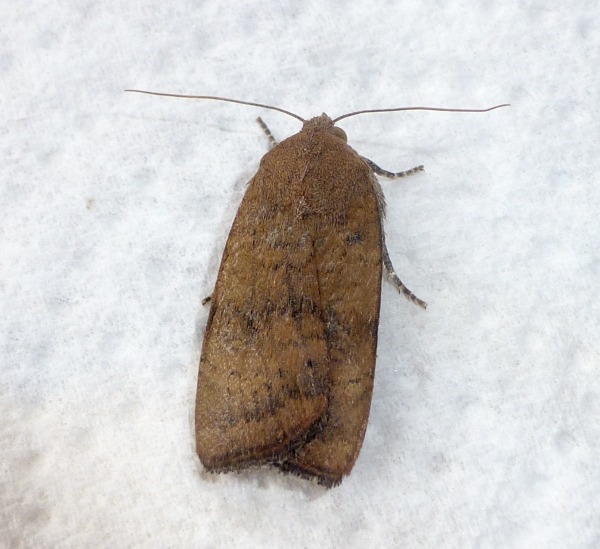 |
| Least Yellow Underwing - new for the modest garden list |
With the weather still rather inclement we did a few brief chores in the cottage for the rest of the morning. My VLW had promised me that I wouldn't need to do any DIY whilst there but in the end I did have to change a washer on a tap that was about to go. We then had lunch before deciding on an afternoon outing. The others fancied a wander around PZ so I offered to drop them off and then go to the Hayle estuary to pay a visit to the over-summering Ring-billed Gull there which I'd not yet seen. The traffic was terrible in both directions around the town so it took some time to drop them off and get out to Hayle where I first had to run a quick shopping errand before I could get down to some summer gulling ("had me a blast, tell me more, tell me more" *). Regular readers may recall that my last few visits to Hayle this year searching for gulls (Caspian and possible American Herring Gull) had been less than fruitful and sadly this theme continued this time as most of them were fast asleep and rather difficult to make out. I met another birder there who said that he'd seen the Ring-billed just before I'd arrived but couldn't find it now. Had I been sensible I would have done my research and studied photos of the bird so that I could pick it out even with its head tucked in but unfortunately I hadn't done this. Instead I noted a flock of 40 odd Dunlin, 6 Redshank, a scattering of Curlew and three Mediterranean Gulls (adult and two second summer) as well as the usual loafing large gulls.
 |
| I'm always happy to see Med. Gulls |
I was supposed to rendezvous with the family for tea back at PZ at 4 pm but given the traffic it had taken too much time to get there at all so in the end I gave up on the tea and arranged to pick the rest of the family up after they'd finished theirs. This I duly did and we went back to the cottage to pack up. The wind was still very strong so in the end I had to carefully deposit the moths from my trapping in the undergrowth in the garden out of the wind where it wasn't too damp. During the night the wind abated so they should have all managed to fly off somewhere safely. We finished all that could be done in terms of packing up and then watched some crappy film on the TV. We were all rather tired so went to bed early.
 |
| I found some Mexican Fleabane growing by the wall at the Hayle estuary |
* Paraphrasing the musical Grease in case you're wondering what on earth I'm going on about
25th July Homeward Bound
This morning we woke early to reasonably fine weather. There was no lounging about in bed for us today so we got up and packed as we had to be out by 10 a.m. for the cleaners to come and make ready for our holiday guests for next week. We managed to leave on time and stopped off to recycle what we could at Pendeen and Tescos. Then there was one more stop to pick up some journey sandwiches before we hit the road. The A30 was predictably chocker with all the holiday makers leaving at the same time and we spent about an hour and a half crawling along near Bodmin before we were able to get going again. After that it wasn't too bad with just a bit of heavy traffic near the M5/M4 junction. We arrived home late afternoon tired but pleased to be back only to find that our electric circuit breaker had tripped out yesterday and that the entire contents of our freezer (thankfully not too much) had to be disposed of. Still, that didn't really spoil what had been a great week away.
I will do another final posting in the next few days once I've caught up with all my moth and flower photo ID's. In the mean time I'll leave you with a couple of left-over Pendeen photos.
 |
| Pendeen Stonechat |
 |
| Dodder - a parasitic plant that uses Gorse and Heather as a host |
We are in fact due back again in a week's time for our official Cornish
holiday - this week having been a bonus break due to the cottage not
having been booked. So, with dips on the Ring-billed Gull and Common
Hawker to revenge, I'll be posting again here soon.
30th July Mopping Up
So I'm back home, and looking on in frustration as this week first a possible Kermadec Petrel is seen feeding off my beloved Pendeen, and then a Barolo (née Little) Shearwater goes past as well. Such is life!
I've finally finished going through all my moth and plant photos. There's not been anything too exciting that I've not reported from before apart from several Small Mottled Willows, immigrant moths which I'd overlooked in the first instance because they are rather drab looking and I was not familiar with them. Back home in Oxford I would get rather excited to find this in the moth trap though I suspect that it's less of a big deal down here in Cornwall.
 |
| Small Mottled Willow |
One story that I didn't mention whilst I was down was that of the Swallows that are breeding in the barn next to our cottage. When we arrived they were were four youngsters just about ready to fledge. During our stay they left the nest though would largely stay in the barn where the adults would bring them food. One day just after they'd fledged, as we were about to get into the car to go out for the day I heard a great commotion and saw all four youngsters flying about in their clumsy way. The cause of this fuss soon became apparent when a Sparrowhawk was seen bombing around, hotly pursued by the parents who were calling loudly. By the time the hawk had gone there was no sign of the youngsters at all and the parents were circling around calling plaintively to try and find them. This went on for at least half an hour and we left the cottage for the day rather worried that they had been scattered to the four winds and wouldn't be able to fend for themselves. Fortunately when we arrived back that evening all four birds were back in their barn safe and sound. We were all very relieved.
 |
| The young Swallows, shortly before fledging |
Looking back on the holiday, the highlights for me were the great mothing (I added at seventeen species to my rather modest life list total) and the great views of the Cory's Shearwater as it went past Pendeen. I also added a number of new plants to my list though as that is even more modest than my moth list so it's not saying much. Still it keeps me occupied during the summer months.
 |
| English Stonecrop - a tiny succulent flower |


