Wednesday, 4 August 2021

Farmoor Purple Sandpiper

I was in the middle of an evening Zoom call when my mobile rang. It's quite an unusual time for a call - I noted that it was fellow county birder EU calling but somehow didn't twig as to what this could mean. Towards the end of my meeting which normally goes on to 8:30 pm he called again. Once again I declined the call but quickly checked on-line where I soon discovered the reason for his persistence: Purple Sandpiper at Farmoor!! Now this species has only been seen once in the county since I started birding back in 2008 and I was away at the time so this would be a mega grip back county tick for me. Still I was stuck in my meeting for which I really needed 100% concentration. Fortunately it wound up 15 minutes earlier than usual so I got my gear together and hurried off.

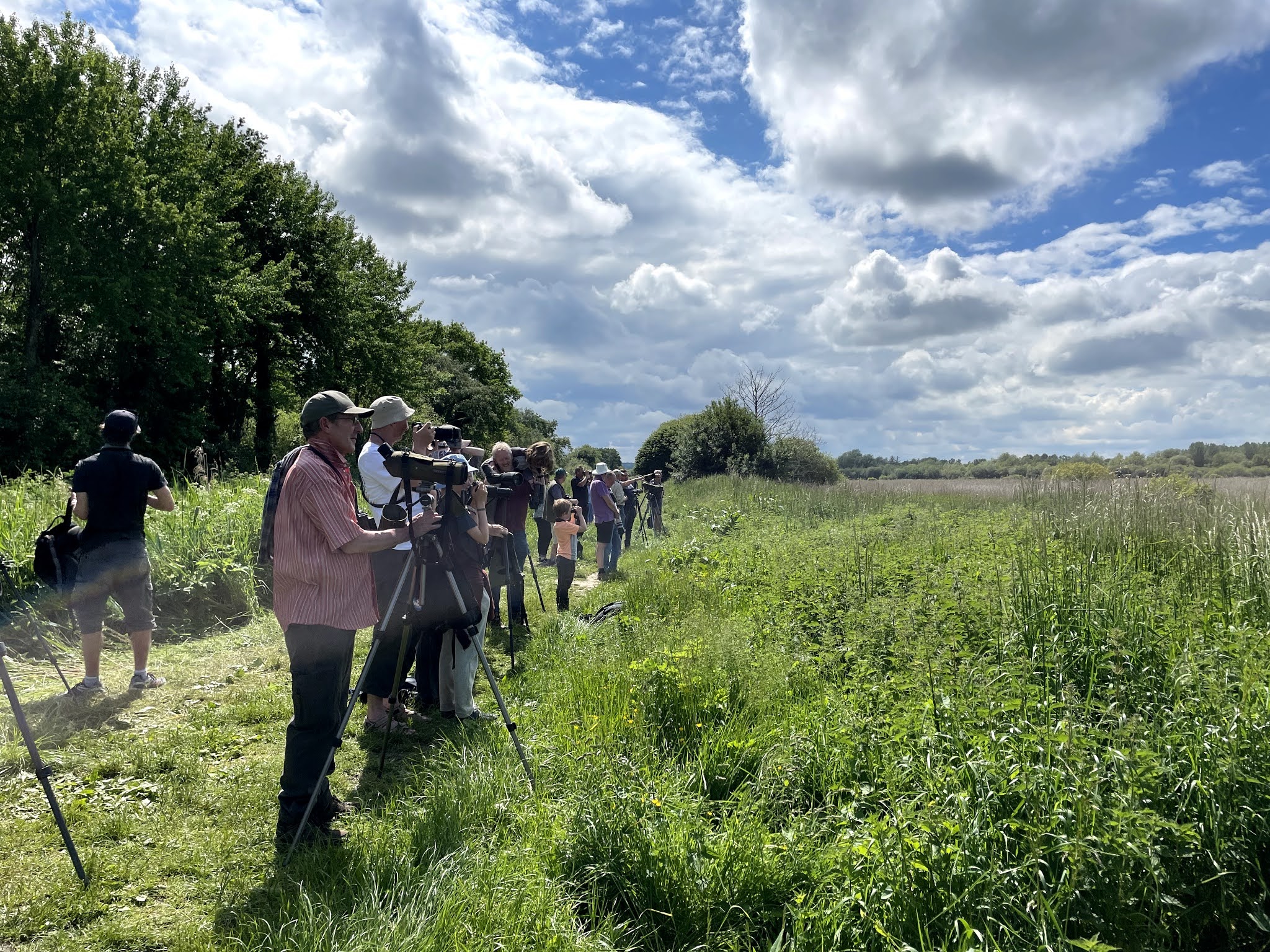
En route I gave EU a quick call on the hands-free and he told me not to park in the car park (it was getting rather late now anyway and there would be a danger of being locked in) but instead to go down the side road towards Lower Whitley Farm and make my way in that way. There was thankfully very little traffic and I made good time. As I was passing the main car park EU pulled out and escorted me to the spot I needed to go. Within a few minutes I was parked up and yomping the few yards along the causeway towards a very relaxed looking handful of Oxon's finest. The Sandpiper turned out to be asleep just a few yards away on the bank and didn't seem to mind birders coming quite close to take photos. However the light was so bad that most of my efforts turned out to be rubbish.

The best I could manage in the gloomy conditions

As usually happens in such situations we soon got to chatting about birding instead of looking at the bird - with my county tick under my belt it was all very relaxed and pleasant. Finally, one of us bothered to look at the bird again to discover that it has woken up and was now feeding half heartedly along the shoreline. I can only guess that it was very tired after it's long journey. Anyway, it was a great opportunity to take some close up video.


Video is much more forgiving in poor light conditions and the bird allowed very close approach

Eventually it started to get rather dark so I wandered back to the car and drove the short distance back into Oxford and back to Casa Gnome. It had been nice to go out a county twitch again: my first of this year and a great interruption of my meeting. As a post script, news broke the next morning that the bird was still around so those who hadn't been able to make it the first evening were able to connect. I wonder how long it will linger.


Monday, 26 July 2021

New Forest Frolics: Orchids & Buzzards

This is traditionally a quiet time of year, one that birders often fill by turning to other things to while away the time until autumn migration kicks off. Over the years in the summer months I have dabbled in butterflies, odonata, and flowers, in particular orchids. Whilst I've basically done butterflies and odonata (apart from the Scottish specialities of the latter) I've more or less given up on flowers (though I will take note of flora of interest en passant). However, I am still working my way through all the UK orchids. Not that I am a total "orchid head" like some enthusiasts but nevertheless it's a nice excuse to get out and see things during the summer months. This year I was determined to go and see the Late Spider Orchids in Kent but somehow that never happened. To make amends I've been on a couple of recent trips to mop up two orchid species that it is possible to see in the south of the country, namely Heath Fragrant Orchid and Bog Orchid.

The first trip was a few weeks ago. With the rest of my family all off doing things of their own, I decided on a day out myself and settled on Boundway Hill in the southern part of the New Forest just west of Sway where I'd been told I could find Heath Fragrant Orchids. The two hour journey was uneventful and despite my concerns, the orchids turned out to be very easy to find as there was an obvious boggy area down the hill within a hundred yards of the car park. The vast majority were Heath Spotted Orchids with perhaps a couple of dozen Heath Fragrants dotted in amongst them.


Heath Fragrant Orchids

One of many Heath Spotted Orchids

There were also lots of interesting bog plants including Bog Pimpernel, Bog Asphodel and two species of Sundew.

Bog Asphodel

Bog Pimpernel

Great Sundew

Round-leaved Sundew

In one small copse were some rather unusual orchids which to my inexpert eye looked like hybrid HF x HSO.


Heath Fragrant x Heath Spotted Orchid

I'd met IE and his son at the car park just as they were leaving and they'd reported lots of other orchid species but all I could find was a single candidate Common Spotted Orchid. I whiled away a pleasant hour and a half browsing all the orchids in the warm sunshine. Then it was back to the Gnome-mobile and back home.

The second trip was last week to catch up with one of the hardest orchids to see: the diminutive Bog Orchid. These tiny plants are notoriously difficult to find even when you know that you are in the right bog so when IE told me that he has a really good site for them I jumped at the chance. The extremely hot weather was going to be back to more reasonable levels on Friday and with rain forecast for the weekend I decided to take that day off work and to head down to the New Forest once again. Despite it being the first day of the school holidays there was little traffic on the A34 and I had a good run down. I duly arrived at the bog in question and after a few minutes I'd found my first Bog Orchid. 

My first Bog Orchid!

A bit of further searching soon turned up a few more


Just so you get a sense of how small they are!

As I had something else lined up after the Bog Orchids I decided that three was plenty to have seen so rather than searching for more (IE had had 15 of them in total) I headed to my second destination which was a good Honey Buzzard site that I'd been told about (please don't ask me as I'm sworn to secrecy!).

I arrived to find a chap called GD already at the viewing point. This was most fortuitous as he was a veteran HB watcher and was able to distinguish my target from their commoner cousins at a great distance. He'd told me that things had been very quiet that morning. By the time I arrived at 11:45 am he'd only had one sighting at 9am with just a smattering of Commons since then. My arrival seemed to perk things up because after that we had lots of sightings, mostly Commons but with several very good flight views of Honeys along with a couple of bonus Goshawk views and a single Red Kite (more rare there than back home at Oxford). With a Restart and a Woodlark as additional bonus sightings it ended up being a most enjoyable session and it was in a contented frame of mind that I headed back home to Oxford.


Thursday, 10 June 2021

Cornwall In June

Over half term we had a family trip down to Cornwall again. Regular readers will be aware that we are trying to sell our cottage there but, despite a rampant property market down there, because of the pop-up campsite we have had no takers. So we decided to let it out over the summer again as usual which necessitated a trip down there to get things ready for the season. With two out of three children in tow we headed off on Tuesday for the rest of the week.

The birding down there seemed to have peaked on the Sunday before we arrived with loads of goodies (Golden Oriel, Woodchat Shrike, Red-backed Shrike and Black Stork) all being seen on the same day. However, since then it was more like a typical June with not much at all on offer. The first couple of days I spent some time failing to track down the lingering but elusive Black Stork that was being seen occasionally at Rosewall Hill (Buttermilk Hill as the locals know it). Despite putting in a quite a few hours in the end, I never got to see it.

A distant Cuckoo on Rosewall Hill was scant compensation for not seeing the Black Stork

 
Hill top Painted Lady

This Grey Gorse Piercer (Cydia ulicetana) was actually a moth lifer. It was plentiful on the gorse flowers on the summit.

Our stay at Pendeen followed the usual pattern of DIY in the morning and then doing something in the afternoon. We had a family trip to Trewidden gardens and a walk down Kenidjack, around Cape Cornwall and back via Carn Gloose which was nice but offered nothing out of the ordinary in terms of sightings. Still, May and early June are beautiful times of the year down in Cornwall and it was enough just to enjoy the wonderful scenery and what had turned out to be a great week of weather.


Pendeen Whitethroat

Garden Goldfinch

Beautiful Demoiselle at Kenidjack

Towards the end of the week it turned very foggy at Pendeen and putting the outside porch ("moth light") on brought in quite a few species.

Cream Spot Tiger

Fox Moth

Spectacle

On Saturday some of the family wanted to head into Mousehole for a while to explore the shops and have some tea. After dropping them off I elected instead first to head to Newlyn to see if the long-staying American Herring Gull was around. However despite searching all the usual spots I could not find it at all. At this point I got confirmation from P&H that a Rose-coloured Starling was still present at St Buryan after having first been reported the previous night so I cut short my gull search and sped over there instead. It was very misty at St Buryan when I arrived and parked up in the side road where it had been seen. Still after less than ten minutes of wandering around it turned up, stting first on a telegraph pole and then on a roof-top - classic views! Despite the mist I managed some photos.


Rose-coloured Starling at St Buryan
 

That afternoon we were due to visit my VLW's niece up county a bit but the weather turned rather bad and I started to feel unwell (I was fighting off a nasty cold that our son has had all week) so we headed back to the cottage to start packing up instead.

On Sunday we decided to head back home via Glastonbury (which we'd been meaning to visit for many years) which just happened to be close to Ham Wall RSPB where a certain River Warbler was by coincidence currently on territory. The traffic was heavy all the way up on the A30 and also on the M5 up to our turn off. With a sign warning of hour long delays up ahead we were grateful finally to turn off and head for Glastonbury. I dropped the others off in the city centre and then hurried back to Ham Wall. I was very much aware that I had limited amount of time and as it was now afternoon and getting rather hot, it was possible that the bird (which is known to sing in the night) might well take a siesta. So I hurried along the familiar track towards the twitch spot. 

Ham Wall is one of my favourite reserves. This was my fifth visit but each previous time it had delivered in the form of a new personal UK tick. I had this site to thank for Pied-billed Grebe, Hudsonian Godwit, Little Bittern and Collard Pratincole - could I add River Warbler to this list? After a brisk 10 minute walk I crossed the first footbridge over the drain and hurried to join about a dozen or so other birders. The twitch arena turned out to be a length of about 30 yards long, facing towards a reedbed across an area of srub and reeds. I asked about when it was last seen and was told about half an hour ago. I set up my gear and settled down to wait.

Fellow Twitchers waiting for the bird to show

 
The reedbed in which the River Warbler was hiding

There was plenty of other birds to see and hear. With several Cetti's Warblers singing within earshot, a hawking Hobby and regular sightings of Marsh Harriers and Great White Egrets it was a lovely place to be waiting. The only issue was that I knew I was on a tight schedule. After three quarters of waiting with no sighting I was starting to get worried. I knew that the patience of the rest of the family was distinctly finite and I started to contemplate the nightmare scenario of getting "that phone call" from them saying they were fed up and wanted to be picked up, before I'd seen the bird. I had just started to think about when I could come back again when the shout went up that it was flying low down in front of us. I managed to see a large dark brown blob fly towards a clump of reeds with some bare twigs in and a short time later it popped up briefly and started to sing it's weird pulsating whirring song. Just at that moment I got the phone call enquiring how I was getting on. I explained that the bird had just started to show and I would be another three quarters of an hour if that was OK. They agreed and I set about trying to get some photos. The bird was more or less on show constantly at this point, preening in a Hawthorn bush for a while before having another burst of song. The trouble was my auto-focus was really struggling to pick it out in amonst all the reeds and I got shot after shot of blurriness. After a while it moved even closer and sat on an exposed stem, in fact so close the autofocus was registering the reeds behind it. Eventually I zoomed all the way in and managed to fluke a couple of shots that turned out OK.


Showing well at last

When it disappeared again I decided to head off back to the family. Having snatched victory from the jaws of defeat it was in an elated mood that I retraced my steps back to the car and then drove back for the rendezvous. The others had very much felt that they'd "done" Glastonbury which turned out to be very alternative with all the shops being New Agey of some description. All very well as far as it goes but after wandering around for a bit the others felt that it was rather samey.

With a couple of hours on the road still ahead of us, we chose a scenic route back home that avoided the rest of the M5 and the rest of the journey passed uneventfully. It has been a nice change of scenery down in Cornwall and whilst the birding had been quiet I'd managed to get a nice bird on the way back home which more than made up for it.


Tuesday, 13 April 2021

Barcombe White-throated Sparrow

It's weird - last year my birding trips were few in number and modest in target but this year here I am posting about my second national sortie within a week. After my epic DIY trip down to Cornwall during the week this was a much more straight-forward affair. My attention had been caught be the long-staying White-throated Sparrow at Barcombe in Sussex. This had been around for a couple of months at least but initially the location was heavily suppressed. Gradually news has been leaking out but for a while it went quiet and we all assumed that it was gone. However on Thursday evening it was reported as still being around "recently" which must have prompted someone to go and check it out the next day. With news breaking of it still being present on Friday I decided that I would see if I could go and see it over the weekend. In the end I was too tired on Saturday after a long week so I opted for a Sunday trip. 

As my journey there would take me right past my VLW's brother's place in Surrey we arranged for me to drop her off there. All her siblings were going to be there as sadly her eldest brother is very unwell so it would be a good opportunity for her to catch up with the rest of her family. This did mean that we left later than I otherwise would have done had I been flying solo and what with the detour to drop my VLW off it wasn't until midday that I finally arrived at Barcombe. Fortunately I was able to grab the last parking space in the small car park next to the recreation ground and I was soon tooled up and hurrying over to the twitch area. From reading on the internet, the bird had been giving visitors quite the run-around in previous days and was by no means guaranteed but I arrived to find that a picnic table on a small bit of decking had been well seeded up and all the twitchers were standing around it, at a reasonable distance, waiting for the bird to turn up. It all seemed very relaxed and civilised!

The seeded picnic table is on the left behind the red life buoy stand

 
I asked someone how frequently the bird was showing and the answer seemed to be every 40 minutes or so. I was also told that it would not linger long on the table, perhaps a minute at most so I got my superzoom camera all primed up and ready in preparation. 
 
Time passed, I nibbled on my packed lunch and drank my tea. There were other birds to watch with several flycatching Chiffies about, a singing Nuthatch and various miscellaneous fly-overs. It was probably a little more than 40 minutes after my arrival when someone called the bird out, sitting to the right of the decking area in a small tree. I managed to see it clearly enough for a couple of seconds before it flew off. Having now actually seen my target I felt more relaxed and I went back to waiting for better views.
 
A little while later I heard it singing for the first time, a thin clear whistly song. Sometime after that and it was back on the decking though again only for a matter of seconds. So now I had seen it twice but still had no photos. I waiting some more and finally it landed on the table and fed for about a minute. I papped away as best I could with my superzoom and managed to capture some reasonable record shots of this lovely looking bird.


All in all it was a very smart looking bird, with very striking yellow blobs on it's forehead either side of the bill, the lovely stripy pattern on its head and it's white bib. This strong head patterning was very much a contrast to the muted drab colours of the rest of it, with grey underparts and rich brown upperparts. The jizz was certainly different from our Old World Sparrows and with its long cocked tail it was rather striking.

All too quickly it was off again and that was the last time I saw it. It did have an extended singing session deep in the copse, though not in any way viewable. I hung about as long as I could in case it showed again but it was not to be.

Conscious of the time and that I had to go and pick up my VLW on the way back, at around 2:30pm I was back in the Gnome mobile and heading back to Surrey and my brother-in-law's place. There I had a reviving cup of tea and a chance to catch up with the rest of my VLW's family. Then it was back on the road and back to Casa Gnome. It had been a nice straight-forward twitch, with my third Nearctic lifer within a week.


Monday, 12 April 2021

Gnome In Cornwall: The End?

Regular readers will know of our cottage in Pendeen and how I have been visiting every year, sometimes alone and sometimes en famille. They will also know of the relentless DIY tasks that are involved in maintaining a cottage in such a beautiful but wind-swept location. For a few years now we'd been asking ourselves how much longer we wanted to keep on doing this. It never quite felt like a holiday if we always had chores to do. But it was the grief of the pop-up campsite counter-blanaced by the rampantly buoyant property market in the South West that finally pushed us to do something about it. So it was that we decided to spruce up the place a bit and then to put it on the market to see what we might get for it. With this intention I volunteered to go down for a few days to try to get it ready. Of course there was the small matter of a couple of decent birds, namely the Exmouth Mockingbird and the Newlyn American Herring Gull, to be seen en route that made the prospect more palatable. I should also add that whilst strictly speaking one is not allowed to visit second homes until 12th April, it is permitted for selling purposes so I was complying with Government Covid guidelines.

So it was, after rather a restless night in anticipation of finally getting out and seeing some birds again, that I was on the road shortly after 8 a.m. along the familiar route to the South West. News of the Mockingbird had already dropped on RBA so I was in a relaxed frame of mind as I steered the Gnome mobile on her course. The traffic was light and I made excellent time down to the Exmouth turn-off when some ten minutes later I was parking up in Iona Avenue and getting tooled up. I had done a fair bit of pre trip research in order fully to acquaint myself with the location - for this particular site, knowing all the viewing angles from the different sides was more important than usual due to social distancing considerations and also due to rather strained relationship with some of the neighbours who had got fed up with birders climbing their walls and breaking their fences. So I had carefully read up all the gen on the BirdForum thread on the bird. 

To start with I went to the main road where I found a couple of birders peering through a gap in someone's fence into the neighbouring gardens where the favoured Holly bush and Palm trees could be seen. A quick enquiry revealed that they had not yet seen the bird in the twenty minutes that they had been there. I decided to do a quick tour and found the infamous alleyway which was very narrow indeed and no place for any social distancing so I decided to steer clear of there. Down Cauleston Close there was a narrow gap between the houses where the Holly tree could be viewed but it was hardly ideal and felt rather intrusive on the locals. Back on the main road the two birders told me that the neighbour whose fence gap they were looking through was getting very cross and kept putting up barriers to try to block the view. In the end it was obvious to me that the best viewing point was on the opposite side of the road where you had perfectly good scope views of relevant trees without having to intrude on any of the neighbours' privacy. Having duly set up it wasn't long before the Mockingbird appeared in it's favoured tree again. In colouring it very much reminded me of a Thrush sized Barred Warbler though with it's long tail and bill that was as far as the comparison went. It would sit still for long periods of time so there was no issue with tracking it or taking photos. It seemed relaxed and content and indeed during the entire time I was there I only saw it fly into the neighbouring Palm trees in order to feed on two occasions so I guess that it had already done much of its feeding for the day. I spent some time digiscoping it and some of them came out OK.


There were not many birders on site: during my time there I saw a total of six others. With the "stay local" restrictions having been eased at the end of last month most people who were going to come to see this bird had already done so. Most of the time the bird was on view, sitting in the tree and doing not very much. The original pair had gone down the alleyway to try their luck but the rest of us stuck to the far side of the road. After about an hour I decided that I had had my fill and headed back to the car. Having now got my head around the geography of the place I realised that, near where I'd parked, there was a narrow gap between the houses on Iona Avenue where one of the Palms could be seen. Just as I took a look the Mockingbird flew up into it and gave me what were the closest views of the entire time while it fed briefly before heading back to the Holly Tree (which was hidden from this vantage point).


This was a great finale for my visit and well satisfied but with much still to do ahead of my I fired up the Gnome Mobile and headed back onto the road. There had been no news on the American Herring Gull so far that day but an hour from Penzance the reassurring "still present" message came on my RBA app and I could relax for the rest of the trip. Arriving in Penzance I navigated my way straight around to Newlyn Harbour. I had intended to park at Sandy Cove, an area of hard-standing near the shore just as you leave Newlyn but there were loads of "Private Land" message showing everywhere so I guess that this was no longer possible. As I headed back I noticed a parked car on a single yellow line just above the beach where the gull was located. Remembering that it was a bank holiday I realised that I could park right on site and duly did so.

I got out of the car, to be greeted by a stiff northerly breeze. From my vantage point I could look right down on the beach which I recognised from various on-line photos of the bird and which I knew well from many past visits. There were only half a dozen gulls loafing on the beach and none was the bird I was after. Somewhat deflated I suddenly realised how tired I was. Was I going to have to come back later to see it? I stared disconsolately out at the harbour. A few gulls had noticed me lingering and flew closer to investigate - on the off-chance that I might feed them, I guess. One of them immediately stood out in flight as having very dark tail coverts. Even in flight I could also pick out the paler head and the "Glauc" like pink bill with a dark tip. Bingo - I had my bird! Rejuvenated by my success I decided to take my packed lunch and flask of tea down to the beach and to enjoy the company of the bird.

My first view of the American Herring Gull, looking down from where I had parked the car
 

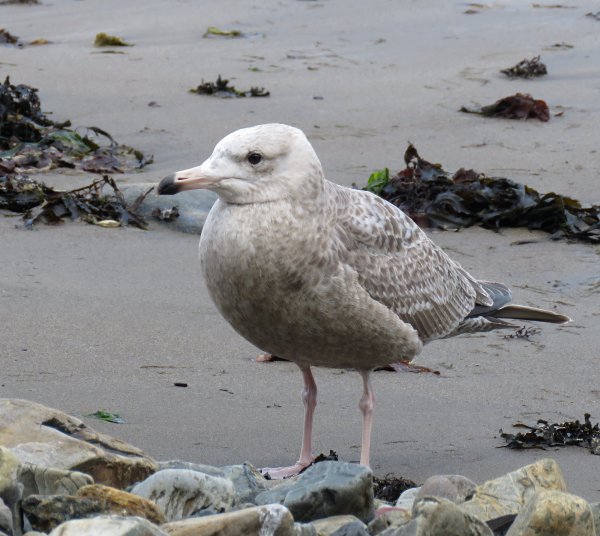
Down on the beach near the tiny memorial chapel there were a couple walking their dog and throwing sticks for the dog all along the beach. I went over towards the gulls and decided to chuck in a few pieces of bread, as much to try and disuade the dog walkers from encroaching in this area as attracting the gulls. Fortunately, the dog people got the message and kept their activities to the far end and with my bread throwing I had got the attention of all the local gulls, numbering some three dozen or so gulls in total. Most were first winter birds, mostly Herring with a few Great Black-backed in amongst them and of course our Neartic interloper as well. From the numerous photos on the internet of this bird, I already knew how striking it was but it did really stand out from the crowd. To my mind it had almost a Glauc feel to it, with it's pale coffee wash to it, it's chunky size and of course the pink bill with the dark tip. The head was pale and it had a nice milky-coffee wash to the breast. The upper and lower tail coverts were strikingly dark and it had the pale bases to the greater coverts, at least on the outer edge of the wing. One thing that really struck me what the head shape which was noticeably different from the other Herring gulls, with a more rounded shape to it. All in all a pretty classic "smithy". I say all this with all the assurance of someone with only text book knowledge of them and who'd never actually seen one in the field before. It was great though that my first should be such a classic bird and one that was showing so well. 


I particularly like this photo which nicely shows just how
stand-out the AHG was compared to the local birds


The obligatory UTC shot


I sat and munched my lunch, sharing bits of it with the assembled throng. The AHG actually hung back from trying to fight for scraps and merely watched from a distance. Still it was close enough that I could shoot some video by balancing my superzoom camera on my knees.


Between myself and the gulls we soon managed to polish off my lunch and after a couple of reviving cups of tea from my flask it was time to get on. 

My first stop was just down the road a Jubilee Pool in order to see if there were any roosting Purple Sandpipers. Sadly the tide was too far out but I did manage to see a few on the small rocky island opposite the monument next to the pool. Then it was on to Sainsbury's in order to pick up some food for my stay before heading over to open up the cottage. With lots to do in a short space of time I cracked on with making a start on the preparations until I was too tired to work any more and so I turned in, dreaming of Mockingbirds and Gulls.

I woke up early the next day with much to do. I won't bore readers with a blow by blow account of all my DIY preparatations - after all this is a birding blog rather than anything else. I did manage to get out briefly in the morning with one of the Pendeen locals who showed me an aberrant Chiffchaff singing in a nearby plantation. So most chiffchaffs go: "jit ja ja jit..." etc. Iberian chiffies go: "jit ja ja jit, weet weet, cha cha cha cha" (as we all learnt to our cost here in Oxon with a weird aberrant bird a few years ago). Well, this bird was going "weet, weet, jit ja ja jit" - a sort of backward half Iberian. It also never once dipped its tail which was most unusually. Not sure exactly what it was then but it seemed to have some Iberian influences. You can listen to a recording here.

Later that afternoon I went up the carn behind Pendeen village to look for a female Ring Ouzel that had been seen there but in the strong wind I could not find it. Once again I worked until I was too tired before turning in for the night.

Pendeen Stonechat

The obligatory Chough photo

I had intended to leave promptly the next morning but in the end I had things to finish off so it wasn't until midday that I finally left. I decided that after such an intense DIY-filled visit I would take a rather leisurely approach to the return journey as a reward for all my efforts. My first stop was at Drozmary Pool near Bolventor on Bodmin Moor where I soon had distant views of the long-staying female Ring-necked Duck and the adult male Scaup. The only other birds there were a female Tufted Duck and a Gadwall.

I also stopped at a service station to eat my lunch and to have a cup of tea before heading on for my third stop at Frampton-upon-Severn Sailing Lake for the long-staying 1w Bonaparte's Gull. This turned out to be a lovely site. After the harshness of the Cornish landscape everything was "soft" and more spring-like. There were hirundines everywhere hawking over the lake with singing Willow Warblers in the bushes. Unfortunately the gulls were all right in the far corner and despite grilling them all very carefully a number of times there was no sign of the Bonaparte's. In the end I gave up and headed on for home, arriving back feeling very tired after an intense few days away. Still I'd managed to see a couple of new birds and things were ready to move ahead with the cottage. 


Addendum

The Mockingbird did its credentials no harm by leaving a few days after I saw it. Amazingly, it was picked up in Pulborough, Sussex where it spent one day before moving on. My sketchy understanding is that the eastern subspecies is largely resident whereas the western ones do undergo a migration of some sorts so this could be one of those that has somehow (perhaps with the aid of a ship) made it to our shores. In any event it was a great bird to see.


Thursday, 4 February 2021

The Durham Run: Beating the Lockdown

As documented last month, our eldest daughter came back for Christmas (Nosterfield Lesser Yellowlegs and Snow Bunting in terms of birds seen). At the start of the new year and with Lockdown 3.0 looming on the horizon we decided that we would head back early in order to beat the Lockdown deadline. So it was that on New Year's Day we set off at around 9 a.m. to head back northwards. The roads were wonderfully empty, so much so that I trounced my previous record time for the journey - if only it was always like that! 

After unloading all my daughter's stuff and grabbing some lunch and a cup of tea I found myself with an afternoon's birding ahead of me in the North East. As usual I had done my reasearch on what was about but at this time of year it was slim pickings so in the end I opted for the long staying Northern Eider (S. m. borealis) that was overwintering at Redcar. This subspecies was not one that I knew anything about or indeed even had heard of previously but it kept flashing up on my RBA app as something that I had not seen before and this had nudged me into learning more about them. It turns out that the drakes can fairly easily be distinguished from our more usual Common Eiders by a combination of a more colourful bill that was orangey rather than the "mucus green" that Common Eider typically have and more easily by the two mini "sails" that they have on their backs - see this article for more details. That seemed like a reasonable target bird to aim for, a sub-species tick no less and it would also give me an opportunity to bird the south side of the Tees estuary, somewhere I'd not hitherto visited. So it was that I set off on the three quarters of an hour journey from Durham before arriving at Redcar beach and parking up near the bandstand landmark that was often referenced in reports of the target bird. 

On arrival, I found that in contrast to inland, the weather on the coast was blowing a gale and freezing cold. I donned all my outdoor gear and battled through the winds to the bandstand area. I found a sheltered spot near the bandstand where I could set up my scope without it being shaken about too much and started to scan. This afternoon the tide was in and that and the extreme wind meant that conditions were very choppy. I found the Eider flock but such was the chop that birds were on view for fractions of a second at a time before disappearing in the troughs for many seconds. This meant that picking out details like subtle bill colour or little back sails was really difficult. From where I was the birds were rather distant so I moved to another spot where I could shelter from the wind on the steps leading down from the road to the beach. Here I did my best to work through the fifty or so Eider that were spread along the shore in two or three flocks. I would sometimes get tricked into thinking I had the bird when a gust of wind would ruffle up the back feathers of one of the drakes a little - it was all most frustrating. A close-in Red-throated Diver was scant compensation for this frustrating search. After a good hour and a half of struggling like this I reckon that I'd definitely seen the bird at least once though it was a long way from a satisfactory view. As it started to get dark the flock disappeared from close in shore, presumably moving further out to roost, and I had to give up. 

Looking north from Redcar beach towards South Gare

With a bit of light still left I chose to drive a few miles north from Redcar to South Gare, the area on the south shore of the mouth of the River Tees. This was an interesting combination of industrial wasteland, bordered by a giant chemical works to one side, with sandy dunes to the south and a small harbour and a few outbuildings along the road leading up to the breakwater. There I parked up and had a well deserved cup of tea, watching the sun set over the chemical works on the north shore (romantic or what!?).


Sunset over the north chemical works

Then it was time to head back to Durham to spend the evening with my daughter in her student house. We'd deliberately chosen to come up so early as there wouldn't be any of her house mates back yet so we had the place to ourselves with no Covid concerns to worry about. We ordered a takeaway to be delivered and settled in for an evening of Netflix before turning in for the night.

With nothing else having turned up, my plan for the next day was to head back to Redcar to see if I could get better views of the Northern Eider. Aware that I had a long journey south back home still ahead of me I decided to head off early the next day. I awoke before daylight to find that it was snowing in Durham so after a hasty breakfast I fired up the Gnome mobile and set off in the darkness for Redcar once more. The snow soon stopped and with a much calmer forecast for the day I was looking forward to getting some better views of the Northern Eider. However, I was about a quarter of an hour into my trip when it started to snow again, this time much more heavily and thickly and suddenly driving conditions becamse much more treacherous. There was no going in the outside lane on dual carriage ways which was virgin snow, you had to stick to the inside lane where other cars had already driven. As I got to the Middlesborough ring road the snow was falling thick and fast and I started to see one or two cars broken down on the side of the road. I was just coming off a slip road which sloped down and to the left when I found myself skidding briefly on the bend. Fortunately the ABS kicked in and I was able to regain control. The worst that would have happened would have been I'd bumped into the side barrier but it was a scary moment. A few minutes later, approaching a roadabout (thankfully deserted) once again I skidded briefly as I tried to slow down. Again it was only a matter of a few moments and there was no danger in this instance but it was a surreal feeling of helplessness feeling the car slide with no control over it.

Thankfully there were no further incidents and by the time I reached the parking area at Redcar it had stopped snowing. Mercifully there was no wind to speak of and it was with some keen anticipation that I got tooled up and headed out to look for the Eider flock once more. A few early morning Turnstone were foraging on the beach before it got too crowded as I headed towards the bandstand area. I found the Eider flock easily enough and with the tide out and no wind the chop was much more manageble. Because of this it was only a matter of a few minutes before I found the Northern Eider, which was easy to pick out in the better conditions. I found that I was able to get reasonable close to the flock which was feeding just off shore and so had a go with my Superzoom camera to take some shots


You can see the much brighter bill colour in this shot...


...and the back sails were easy to pick out in the calm conditions

Northern Eider is one of four subspecies and encompasses the birds found in the Arctic regions of the North Atlantic from North East Canada through to Greenland, Iceland and Svalbard. Livezey (1995) suggests that the Common Eider subspecies group should actually be promoted to four separate species: Pacific Eider (S. v-nigrum ), Northern Eider (S. borealis), Canada/American Eider (S. dresseri) and European Eider (S. mollissima). Naturally I would more than happily accept an armchair tick should this happen though in the meantime I will have to settle for a subspecies (and "insurance") tick.

I passed a pleasant hour or so admiring the Northern Eider before deciding that it was time to move on. With nothing else to do I opted to head back to South Gare to see if I could find much of interest. I was just driving along the approach road when I came across a couple of birders walking the opposite way so I wound down the window and enquired as to what might be about. They filled me in, reporting a couple of divers in the estuary and some mobile Snow Buntings along the beach. Armed with this info I parked up and went out to see what I could find.

The two divers were easy enough to pick out: a Great Northern further out and a Red-throated quite close in.

The Red-throated Diver was reasonably close...


...whereas the GND was rather distant

There were quite a few Reed Buntings loitering in the bushes near where I parked and flying back and forth to the dunes.

After a while of exploring the headland I decided to walk along the beach to see if I could find the Snow Bunting flock. I ended up walking quite some distance though never managed to find them but the scenery was pleasant enough and with the long journey home in mind I was pleased to get in some pre-emptive exercise.

The beach south of the break water

The fishermen's huts near the harbour

There was nothing more of note to be seen as I retraced my steps back to the car. There I had a snack and some tea before girding my loins for the journey back. The roads were rather snow-covered to start with at least and it was slow going sticking to the nearside lane behind the lumbering lorries. As I continued south the snow gradually disappeared and the rest of the journey home was uneventful. I arrived back mid afternoon for my usual celebratory cup of tea and a catch-up with the rest of the family. It had been a surprisingly enjoyable trip up to the North East.

South Gare Common Gull